Benny Safdie
Acts
Directs
Let’s
Go!
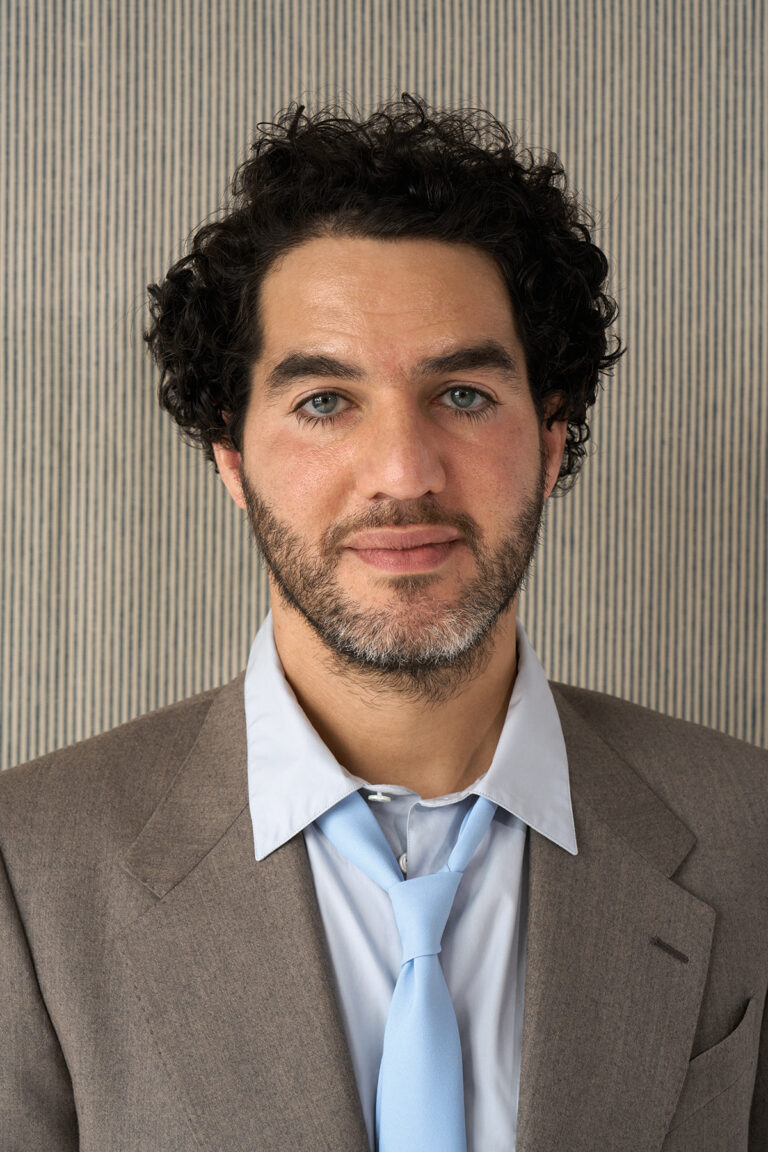
– Is Benny Safdie an indie film director or a big-screen actor?
– Can a great director be good in front of the camera as well as behind it?
– Who was he in ‘Oppenheimer’?
– Has he ever been to Iceland?
– Does he still work with his brother, Josh?
– How much of what Benny does is fiction, and how much is the reality of his life?
– Could his new film about a drug addicted prizefighter be weirdly personal?
– Does he love dogs, and his own children?
– Did he really start going to therapy when he was 14 years old?
– Did he ever dabble with stand-up comedy?
– And what’s with all the turquoise?
– Who is Benny Safdie?
All this is answered over hot dogs in Manhattan.
From Fantastic Man n° 41 — 2025
Story by WHITNEY MALLETT
Photography by ROE ETHRIDGE
Styling by FLORENCE ARNOLD
From a sidewalk on New York’s Upper West Side, Benny Safdie spots a laundry truck unloading stacks of crisp whites swaddled in clear pink plastic. “I want to take a picture but I’m self-conscious,” Safdie admits. “I don’t want it to seem like I’m doing it because you’re writing about me.” He trails off before letting out a resonant, honking, “Ha ha ha” – a classic dad laugh.
The 39-year-old filmmaker and actor is in fact a dad. Together with his wife, Ava, and their two young sons, he lives a short walk from the Upper West Side block where the laundry truck idles, a slice of prosaic neighbourhood routine. He’s dressed as a self-aware blueprint of dads he would’ve seen growing up in the 1990s: Velcro sport sandals, relaxed denim. The ball cap is especially dadcore. His Leica camera – the one he didn’t just use to snap a photo – hangs at the ready on a crossbody strap over a funky-print button-up. He inhabits the deadpan codes of his uniform with sincerity.
“There’s an amazing Garry Winogrand quote,” Safdie recalls as we make our way to the intersection, “something like: ‘I take photographs to see what the world looks like in photographs.’ I’m, like, ‘I get that!’”
Waiting for the traffic light to change, he gets excited about another photo he would’ve taken if I weren’t watching him. An older woman in the throng facing us, crossing the street. “Do you see her, in the stripes, a dog in her arms!?” I catch only a glimpse as she rounds the corner. Safdie has a sharp eye.

Benny Safdie first rose to prominence as one half of the Safdie Brothers, a filmmaking duo formed with his older brother, Josh. Throughout the 2010s they made a string of indie smash hits lauded for their relentless, anxiety-fuelled pace and a commitment to an unflinching, often insanely intense realism. Benny has been distinguished for his obsessive, methodical savvy, whereas Josh is regarded as more responsible for stirring up a frenzied, spiralling energy. This tension is part of what made them such an unstoppable pair. But as the younger Safdie has started carving out his own identity in recent years, this interest in realism has been taking on new shades – often existential and absurd.
As he leads me through the neighbourhood, narrating photos he isn’t taking, there’s an irony in Safdie adjusting his behaviour to avoid seeming performative, only to admit to the affectation. But if you watched ‘The Curse’ – the exquisitely self-conscious series co-created with king of cringe comedy Nathan Fielder – then his neurotic commitment to authenticity, and its inevitable contradictions, won’t come as a surprise. Premiering two years ago, ‘The Curse’ marked a significant turn in Safdie’s career: a step toward distinguishing himself from the Safdie Brothers banner. Collaborating with Fielder, whose shows ‘Nathan for You’ and ‘The Rehearsal’ orchestrate intensely awkward scenarios that lean on reality television’s blurring of fact and fiction, Safdie noticed a peculiar symmetry between their creative paths: “I was obsessed with making fake things feel real, and he was obsessed with making real things feel like they were fake.”
Safdie and Fielder joining forces produced an uncomfortable and urgent meditation on sincerity – a ten-episode cringe dramedy widely acclaimed as one of the most bizarre and boundary-pushing television experiments of recent years. The pair not only co-wrote the series but also starred in it alongside Emma Stone. Fielder and Stone play a married couple attempting to spin the supposed community benefits of their eco-property redevelopment, promoting their “fliplanthropy” through an HGTV reality show. Safdie plays Dougie Schecter, a sleazy reality TV producer incentivised to make the couple look bad for ratings, in this darkly comic satire that exposes how altruism warps grotesquely under capitalism.
“‘The Curse’ is all about where somebody thinks they’re being a good person and does all the right things, says all the right things, but it’s a very philosophical question,” says Safdie. “If two people do the same thing, but one person is doing it from a good place and one isn’t, is it the same?”
Safdie was almost unrecognisable as Dougie. On a Reddit thread dedicated to the show, some viewers admitted they didn’t even realise it was him; others confessed to feeling conflicted about finding Dougie, a desperate compulsive liar with stringy hair, a goatee and a penchant for silver-and-turquoise jewellery, inexplicably hot. Safdie’s natural charisma helps sell that kind of offbeat emotional intensity. In person, he’s got even more rizz than I anticipated. Not everyone can pull off a baseball cap embroidered with the words “be here now,” but he does – and he’s quirked it up, accessorising with a turquoise-studded hat band he picked up from a cowboy store in New Mexico. This subtle nod to Dougie’s preferred adornment is somehow less repellent on real-life Safdie.
***
It was around the press cycle for ‘The Curse’ that news broke of the Safdie Brothers’ amicable professional split, marking a new chapter in Benny’s career. But for those paying close attention, it wasn’t a shock. Following the critical and commercial success of their 2019 film ‘Uncut Gems’ – a jittery doom-spiral propelled by Adam Sandler’s depiction of a New York jeweller addicted to sports betting – Benny Safdie had already begun stepping out on his own, proving himself as an in-demand character actor with surprising range. Between ‘Uncut Gems’ and ‘The Curse’, Benny landed roles with a couple of all-time great auteurs, Paul Thomas Anderson and Claire Denis. Most people go from actor to director. Safdie went the other way.
Safdie first turned heads as an actor eight years ago in ‘Good Time’, the hard-edged thriller that he also co-directed with his brother. He played Robert Pattinson’s developmentally disabled brother, with Pattinson as a reckless older sibling trying desperately to rescue him through a series of bad-to-worse decisions. It was a role Safdie says he connected to on a personal level. “I can relate to that character in a very deep way, where I don’t want to talk about how I feel. I’m totally fine shutting the door and living by myself. I can do that, but at the same time I know it’s not good for me. That’s part of why I love being in the city,” he says of New York. “It forces interactions. If I lived in LA, it might be a little dangerous for me.”
Despite those tendencies, Safdie seems confident and at ease speaking vulnerably. This might be explained by the fact he’s been in psychotherapy for 25 years. “I had a therapist who told me: ‘It’s like in cancer therapy when they take all the blood out of your body and run it through a machine, out there in front of everyone in the room.’ He said, ‘That’s what we’re doing here, but with your feelings. We’re putting it all out there, examining it and then putting it back in.’”
Safdie describes his father as “chaotic” and his mother as “very loving and caring but just struggles with things.” They divorced when he was only six months old. “I lived with my father in Forest Hills because my mother wasn’t able to care for us at first. That was one part of my life. And then she got herself together and was able to build a foundation. She married my stepfather. When things didn’t work with my father anymore – for many reasons – she said, ‘I have to move you somewhere safer.’ So we moved in with her and my stepfather on the Upper West Side.” Josh, two years older, moved from dad in Queens to mom in Manhattan with Benny. “We both have been through all of this together. We’re trying to understand it together.” He adds, “It gets a little bit more complicated when he’s in high school and I’m in middle school.” Josh wanted to hang out with high school friends without Benny. Benny didn’t want to have any friends. “I was fine by myself.”
In high school, the younger Safdie was into physics and stand-up comedy. He performed at clubs around town as “Zachary Mulden,” a deliberately awkward alter-ego. “He was this guy who was delusional. The things that happened in his life that were really sad, he thought were really funny,” Safdie explains. “I wanted to be as believable as possible. That person on stage was real. If people didn’t believe that, I was doing something wrong. I didn’t want people to laugh with me; actually, I wanted them to laugh at me, and then I wanted them to realise at some point the whole situation had become absurd.”

At Gray’s Papaya, a kitschy, quick-and-cheap fixture of the Upper West Side, Safdie orders two hot dogs with ketchup, mustard and sauerkraut. It’s his regular. Gray’s Papaya is the kind of New York institution that it makes sense Safdie appreciates. ‘Uncut Gems’, after all, shines a light on this kind of old-school slice of Manhattan, with lifelong Diamond District locals playing versions of themselves. The Safdie Brothers’ body of work is often labelled “gritty” – which doesn’t quite capture their deep respect for the city’s theatre of cacophonous, salt-of-the-earth hustle. Safdie tells me he’s been eating hot dogs here at Gray’s since he was a kid. He confesses, “I have a hard time walking by without stopping to eat something.”
We find a spot at one of the red standing tables on the sidewalk in the sun. “I’ll show you a picture of hot dogs I took in Iceland,” he says. According to Benny, the oldest continuous hot dog stand in the world is in Reykjavík, serving their lamb dogs without interruption since 1937. New York’s Papaya King – which Gray’s Papaya is an offshoot of, started by a former Papaya King partner – dates back to 1932, but they only added hot dogs to the menu in 1939. I have a feeling Safdie would do well on ‘Jeopardy!’
He discovered Icelandic hot dogs only recently when he was there filming Christopher Nolan’s ‘The Odyssey’. It’s a major Hollywood epic boasting a star-blitzed cast – Matt Damon, Zendaya and Charlize Theron, to name but a few. Safdie was also in Nolan’s last movie, ‘Oppenheimer’, living up to his scene-stealing reputation as the Hungarian-American theoretical physicist Edward Teller. If you saw the film, then you remember his accent. “Like Dracula,” per Safdie, who maintains the actual historical figure sounded just like that, as campy as his imitation may have seemed.
“Everybody’s always, like, ‘Which do you like better?’” he says about directing versus acting. “They’re different. One helps the other all the time.”
I ask if anyone ever asks which kid he likes better.
“Before I had my second kid, I thought, ‘How in the world can I love someone else this much?’ I didn’t know it would be possible. And then it just happened.” Both kids are hooked on Gray’s Papaya hot dogs. “I shouldn’t be proud, but it’s better than pizza. I mean, these are all-beef.”
***
We leave the hot dog stand and head up Amsterdam Avenue, the Upper West Side’s main artery, and by chance bump into another local filmmaker: Amalia Ulman. It’s surprising to have a run-in in this pocket of New York. The Upper West Side is not a “scene” like the Lower East Side’s Dimes Square; its appeal lies in its complete normalcy, refreshingly free of familiar faces and hip striving.
“Service dog, hello,” Safdie greets Ulman’s German shepherd mix and affectionately dotes.
Ulman hasn’t met Safdie before, but she’s well aware of his influence. Her own debut ‘El Planeta’ premiered at Sundance a decade after the Safdies’ first feature ‘Daddy Longlegs’ played the festival. Today, every emerging auteur navigates a shifting landscape that the brothers helped redefine. They’re kind of the posterchildren of a certain indie-to-Hollywood trajectory. “It was a phenomenon that happened in America more in the ’90s,” Ulman explains later over the phone. “Good directors were given the chance to do interesting movies with bigger budgets and stars, which I think nowadays is pretty rare.”
Part of the story of the Safdie Brothers’ rise is the development of a new kind of boutique film studio. Namely, their ascendancy closely tracks that of A24, the New York-based studio that launched in 2013 aiming to distribute offbeat, auteur-driven cinema with a recognisable cast. The studio had an early hit with Harmony Korine’s ‘Spring Breakers’. The studio’s box-office and critical success only continued throughout the 2010s with releases including Barry Jenkins’s Oscar-winning ‘Moonlight’, Yorgos Lanthimos’s breakout ‘The Lobster’ and Robert Eggers’s cult horror ‘The Witch’. But the Safdie’s first release with A24, ‘Good Time’, had its own singular swag and cultural impact. The film’s neon-lit atmosphere, 2010s track suits and bleached hair all made an imprint on the fashion industry. Not to mention, the film marked a Pattinson rebrand, helping him shed his teenybopper reputation from ‘Twilight’. Distributing it in turn meant significant credibility for A24, helping them reinforce their brand as a safe haven and tastemaker for zeitgeist-fuelled work.
It was a symbiotic relationship: A24 gained clout from the Safdies, while the brothers secured vital backing and growth through the studio’s support. Their partnership has only deepened over time, with A24 coming on early in the development of ‘Uncut Gems’, a film that not only elevated their profile but also broke out Julia Fox – further proof of their instinctive pulse on culture. Even as Benny Safdie has begun working independently of his brother Josh, he has remained closely tied to A24. Both ‘The Curse’ and his forthcoming film ‘The Smashing Machine’ were developed with the studio’s support. The latter is reported to have the joint largest budget in the studio’s history to date, a record shared with his brother’s solo debut, ‘Marty Supreme’.
When I ask him about these broader narratives, Safdie shows little interest in shoptalk or dissecting his idiosyncratic success amid an industry defined by risk aversion. “The only thing I can say is I’m doing what I find exciting. It may not be what people expect me to do, but so what? Trying is a very beautiful thing. You’re very vulnerable in that moment of doing something for the first time because you might fail. I try as a director to create an environment where there’s no pressure at all. It’s not a mistake because you tried that and it didn’t work. It just means that now we know what doesn’t work.”
His solo directorial debut out this October stars Dwayne “The Rock” Johnson as pioneering MMA fighter Mark Kerr. As with all the films the Safdie Brothers are known for – and which the younger’s solo effort will inevitably be measured against – ‘The Smashing Machine’, set in the year 2000 and unfolding largely in Tokyo, is steeped in vibe. In the early days of the Ultimate Fighting Championship (UFC), there was a parallel Japanese league, PRIDE, where American fighters like Mark Kerr became key figures. The film brings to life the electrifying spectacle of these televised stadium matches framed against the continuous, claustrophobic interior space of a large commercial hotel that the protagonist seems barely able to leave: locker rooms, suites, lobbies, utility corridors and service elevators, every detail suffused with the high-gloss atmosphere of Y2K-era Japan. It was The Rock who first came to Safdie with the idea for a film about Kerr’s story, and after watching a documentary on the fighter, he was sold. “My head exploded,” Safdie remembers. “I never stopped thinking about the movie and him being Mark.”
A biopic of recent sports history, the film teaches about the MMA pioneers, who paved the way for today’s champions rewarded with exponentially more prize money and fame for being pulverised for the cameras. What really drives the film, though, is an addiction story – something common across Safdie Brothers movies like ‘Heaven Knows What’ and ‘Uncut Gems’. Kerr’s habit of injecting opiate painkillers catches up with him. He overdoses and makes a go at recovery amidst the pressure cooker of preparing for the biggest fight of his life. The addict/co-dependent relationship takes centre stage, with Emily Blunt starring opposite Johnson as Kerr’s live-in girlfriend, Dawn.
“I showed, through Dawn, feelings I’ve had before,” admits Safdie. “Dealing with somebody who has to get better, doing an intervention is difficult. You’re having to set up a wall and say, ‘I’m not going to let this happen anymore.’ But when the person finally does do it, then there’s sometimes the element of, like, ‘Jesus Christ, just because you’ve been sober for 20 days it doesn’t make you better than me.’ When Dawn says that, that was a very hard line to write, because it’s not a good thing to say. It’s not a nice feeling to have. But I’ve had it: ‘Just because you did that doesn’t make you better than me; I had to deal with this every day for 20 years…’” He trails off. Throughout our time together, Safdie proves a master of boundaries – conveying lived intimacy, without confirming or denying too many details.

Watching the new movie, I found myself curious about Benny Safdie’s emotional life in a way I hadn’t been before – way more interested in what compels him to tell these stories than I ever was during ‘Good Time’ or ‘Uncut Gems’. Is that because I started therapy after those films came out? A consequence of the brothers’ uncoupling? You inevitably imagine a director’s point of view differently when they’re a single person rather than a mythical sibling-duo entity. Or maybe the real reason was the pacing of the new film. There is simply more time to think during ‘The Smashing Machine’. While it shares a lot with earlier works – stylistically, thematically, even echoing concerns of the 2013 documentary Benny and Josh made about basketball player Lenny Cooke – it doesn’t have the stressful pacing the brothers are notorious for. This film is less frantic – and still we feel the intense burden of expectations and failing at them. It’s excruciating in a different way.
“Something we talked about on the set of that movie is there’s this pressure to win,” Safdie explains, “this pressure to achieve something, and this pressure to provide. I said to Dwayne at one point, ‘I know you know what that feels like where you have so many people relying on you for everything. You can’t ever just allow yourself to think about yourself, to be with those emotions and just let that release happen. So imagine how good it would feel to let it all go.’ When he cried in the locker room the first time, I remember the operator, Matthew, kept the camera rolling. I just went in there and I was hysterically crying also. Dwayne and I gave each other the biggest hug, and we were both crying for I don’t know how long. As a director, you usually can’t show whatever you’re feeling. You have to keep everybody on the right path. Because if they see you’re faltering, everything can fall apart. It can be a lot. I wanted to let that go.”
‘The Smashing Machine’ is a lot about the emotional psychology of winning and losing, how people build identities around success and chase it like a high and how they can be avoidant of reality to not lose that sense of self. Safdie tells me he read a book of essays called ‘Losers’, which influenced how he approached telling this story. “What I got out of that book is that winners can sometimes be hard to relate to. Losers are where the heart is. Everybody can understand what it means to lose.”
I think of all the success Safdie’s had, and ask him, a bit cynically, if he really knows what it means to lose.
“Of course I do.”
The way he says it, I believe him.
He reminds me, “You don’t know what anybody’s going through.”
Digital operation by Jonathan Nesteruk. Styling assistance by Abby McDade. Grooming by Rheanne White at Tracey Mattingly Agency. Production by Artist Commissions.