Dirty Clothes
Glimpses of a fashionably filthy wardrobe
YES, it is dirty. YES, I love it.
From Fantastic Man n° 41 – 2025
Text by CHARLIE PORTER
Photography by PATRICIA SCHWOERER
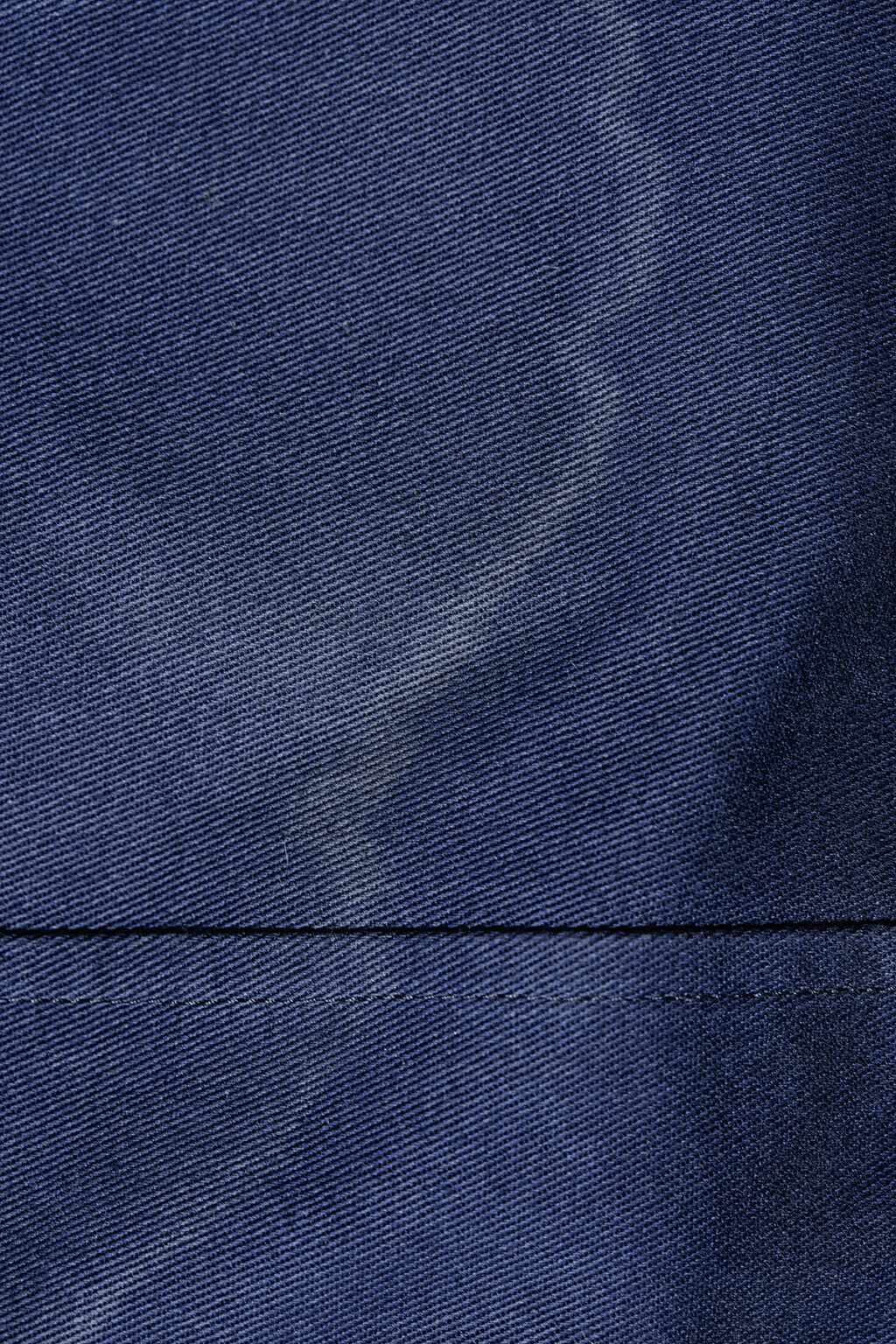
On Saturday, 21 January 2017, I bought a Balenciaga jacket at Colette in Paris. The jacket was from look 17 of Demna’s first ever menswear show for the brand, its men’s clothing designed at the time with Martine Rose. It is a cropped military jacket in cotton twill of a dull navy blue, with extreme and exaggerated shoulders.
I was in Paris as men’s fashion critic for the ‘Financial Times’, reporting from the shows. I wrote reviews daily, on the go, usually crouched in some bar before dashing to that evening’s party. I rarely had time or the inclination to change – what I wore in the day, I wore at night. I know that I was wearing my new Balenciaga jacket during Sunday, 22 January 2017, because, at some point that day, my image was captured by vogue.com’s street-style photographer, Phil Oh.
That night was the last of the menswear season. The shows were over; it was time to let loose. At 1.20am, I took a photograph on my iPhone of a near-naked man’s back. He was muscled and only wearing a pair of tight, white Andrew Christian briefs. Printed on the back of the briefs, across both buttock cheeks, was the branding of the gay dating and chat app Grindr. Apple’s location tracking says I took the photograph in some venue on the Place de la Bourse, close to the junction with Rue Notre-Dame des Victoires.
The photograph prompts no memory of what happened that night. Whatever happened was so energetic, the Balenciaga jacket was left with a sweat tide mark like the ring of a tree. It appears the sweat had spread from my neck outwards. On the front, the sweat mark is less prominent, saved by the double layer of the lapels. But it is there, curving from the centre left of the shoulder down and round.
On the back, the sweat mark creates a full semi-circle from the left-hand side to the right, like those rare moments an entire rainbow is seen from one end to the other. I have dry-cleaned the jacket. The mark remains. My Balenciaga jacket is now as if it had been designed this way, with an intentional sweat mark integral to the dyeing or printing of the cloth.
Many such garments from fashion brands, including Balenciaga, are designed to appear intentionally dirty, a phenomenon studied in the recently opened show ‘Dirty Looks’ at the Barbican Centre in London. It features garments from labels such as Alexander McQueen, Maison Martin Margiela, Vivienne Westwood and Hussein Chalayan. Usually, designed dirtiness – as in, the look of dirt that’s not actually dirty – is intended to flatter the wearer, or to suggest a sense of mystery about them: what fabulous life have they been living to be so messed up, so marked?
Such designed dirt must in some way be desirable. It ruptures the sense of perfection that many garments convey, creating a rawness that reflects well on the character of the wearer. The dirt usually suggests some unspecified action that has taken place, like the tyre-mark prints used in Alexander McQueen’s SS95 collection ‘The Birds’: danger, drama, wildness, rebellion.
The mark on my Balenciaga jacket caused by my neck sweat is humiliating. It suggests some form of physical inability to cope with vigorous movement, as well as a psychological lack of foresight to take off the jacket when I was doing whatever I was doing. Maybe I feared the jacket being stolen if I threw it up the corner of a club?
I adore the design of the jacket. I have a short body and long legs: cropped jackets heighten, exaggerate and flatter my shape. The extreme shoulders push the effect to a maximum. The aesthetic, of subverted functionality, is one that I find magnetic. I often think before I dress: that jacket! I could wear it! And then I remember its shaming stain, and it remains in the closet.
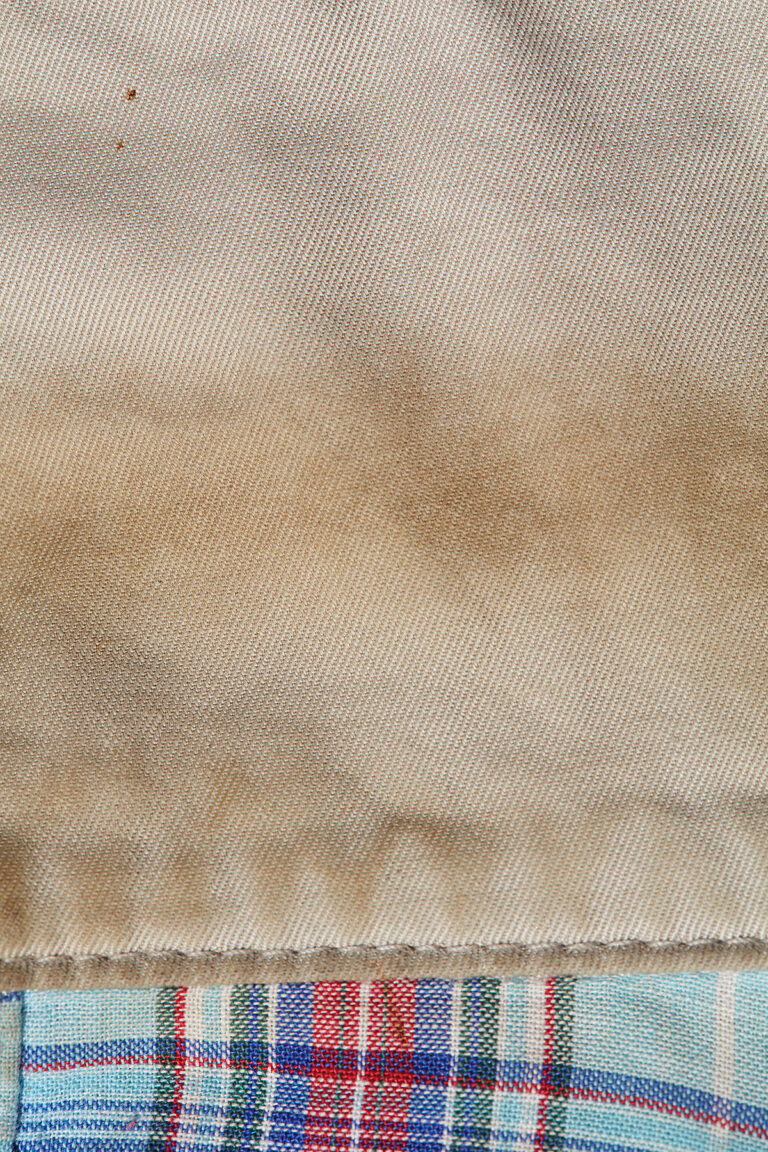
For me, the dirt on the Balenciaga jacket is a rarity. Usually with dirt on my clothes, I don’t care. It is soiling not from one specific moment, but the markings that emerge over time. The other week in London, the weather broke after an extended period of dry and warm days. I needed a practical layer, and remembered a Junya Watanabe khaki functional jacket, made in collaboration with the Japanese label Post O’Alls. Internet research suggests the garment is from 2006; a ticket in the pocket for a Michael Clark Company ballet in Brighton suggests I last wore it in 2018. I put it on and walked the dog.
I just looked at the jacket. The built-up grime at the neck is disgusting, a yellowing never intended on this chic, pale-stone shade of cloth. The dirt mark is as if three dimensional entrenched in the cloth in a low semi-circle defining where the collar has moulded around my neck. It would be out-of-sight for anyone seeing me from a distance, but if I talked up close with anyone, they would see my neck framed by muck. More overt is another build-up of grime leading into the front bucket pocket, from whatever dirt was on my hand as it went in and out. Until I came to write this piece, I was oblivious to it all.
***
My regular winter jacket is a cropped, padded olive-green bomber from Hedi Slimane’s AW15 men’s collection for Saint Laurent. It was look 18, and I remember thinking as it came down the catwalk: I want that jacket. I now wear it whenever the temperature drops. Its cloth has a sheen, but this sheen is now embellished by the shine of grime on its front, particularly around the pockets and at the zip. On the back are stains that look like someone has thrown a cup of coffee at me from behind.
In 2016 I bought a pair of ultra-long, ultra-flared pants in buttercup yellow by Gucci. They were from look 17 of the third menswear season by its then designer Alessandro Michele, his audacity with colour and design in full flow. On the catwalk, the hem of the pants had been tailored slightly up to ensure the accompanying plaid sneakers could be seen in full. At retail, the pants are so long they pool onto the floor.
The hem of the pant is just overlocked, not hemmed. Presumably it was left this way for me to have them tailored to my own desired length. But I like as is. I’m interested in the decisions made in design studios. I have left the trousers full length; the cloth at the hem is now trodden down and sullied. At the left heel, the highest rim of the dirt mark is at nearly 12cm above the hem. The tide line of the most intense heel residue is at 5.3cm. There are many other waves of dirt at these heels. Together, they look like the turmoil of the sea in a painting by J.M.W. Turner.
Looking at the Gucci pants now, I notice new, unexpected dirt. I store my pants piled up flat, shoved in a wardrobe. There is no scheme, meaning different fabrics end up on top of and underneath each other willy-nilly. Many of these pants are cut from denim, which can give off dye. At the centre back of the waistband of the Gucci pants, residue of indigo dye is as if printed on the buttercup yellow, reaching to the first belt loops on either side of the central seam. There is also residue of indigo dye picking out the lines of seams inside, caused by the weight of the piles pushing the pants into each other. The effect is quite beautiful.
It is not just garments. In June last year, I attended the Glastonbury Festival in southwest England. To cope with whatever might occur, I bought the 5-litre waist pack by Patagonia in blue, to be worn crossbody. It has since become my regular daytime bag, being the perfect size to carry notebooks, pens, a paperback, wallet, and phone as well as my reusable coffee cup in its stretch side holder.
The bag is now truly repellent, the stretch side holder darkened by stains, the white zips now a terrain of dirt, the base of the bag showing the filth of whatever floors or surfaces it has been on. I stuck a sticker over its logo to make it look less branded, but that sticker has now mostly peeled away, leaving dirt stuck to the residual glue.
This is not new. Once, during the shows when I was still a critic, I remember some editors opposite pointing at my feet and laughing. I asked them what was up. I had an orange rucksack by the Danish designer Astrid Andersen on the floor beside me. They said, “Your bag is so dirty.” I did not understand them then, I do not understand them now: to me, residual dirt means it has served purpose.


“I think fashion can sometimes idealise the past,” says Alice Gomme, an archivist. For the past 15 years, she has been seeking worn clothes in European rag yards. Her particular interest is in garments from around 1910 to 1940 that have been heavily mended or altered.
Her archive tells a different story of our relationship with garments, away from the niceness of unblemished, clean historisation. She grew up near Portobello Road in west London, a market street known for its secondhand clothing. “The first time I saw a heavily worn, repaired piece, I must have been 17. It hit me like an alien object. Where did it come from? What is it? Why did it look like this?”
We are in her studio north of London Fields in east London. It is specifically impeccably clean. On a rail are a handful of worn garments, ready for a client visiting later that day, a musician researching looks for an album cover. To find these garments is testing. “This man came up to me once in a market in northern France,” she says. At the time, Gomme was wearing an old chore jacket. “He said, ‘Oh you like these clothes, I have some. Do you want to follow me?’”
They drove in convoy for a few hours into the countryside, arriving at the edge of a village. He showed her into a double-height barn filled with a mountain of clothes. “I spent the next three years digging through that site,” she says. “It’s dark, it’s damp, it’s dusty,” says Gomme. “I was completely unprepared in my T-shirt and jeans. My skin was itching for a week. I was coughing.”
The clothing had been gathered by the barn owner’s grandfather, who cycled round a 15-mile radius. Nothing was then done with them, the clothes passed down generations and the grandson now wanted this barn emptied. Gomme soon realised she was digging down through layers of time, working-class garments punctured by the uniforms of two world wars. These dirty clothes were anthropological evidence, previously overlooked.
“If we look back at archaeological digs, even with the tombs in Egypt, everyone wanted the gold and the treasures, and they were throwing away the fabric, but the fabric was sacred. Time and time again, textiles have just been thrown away.”
The garments from the barn resist straightforward classification. “It’s hard for me to tell you about individual pieces,” she says. “If I found something in a pocket, a coin or a shopping list, that gives me more information on who that person might have been.”
Gomme cleans and preserves the garments, then intentionally presents them in a spotless space. “The way in which we present things alters the way we perceive them,” she says. “I have the clothes’ back. I’m here defending them. I’ve experienced ten years of quite derogatory language around clothes, around the act of digging through dirty heaps of things. It’s only in the past five years that people have understood. Now people care.”
Her archive is now wildly envied. A resident of California once asked if he could buy the entire collection from her outright. She declined. Her connection to the garments runs deep. “They’re very personalised,” she says. “People have worn them for a long period of their life. I really believe we live in the fibres of our clothes. Especially the knitwear, they have a lot of energy for me. I feel a lot about them, and the people that wore them.”
***
I am fortunate enough to receive invitations to the twice-yearly sample sale of Brunello Cucinelli. I use the opportunity to get fabulous crew-neck cashmere knits otherwise wildly beyond my wallet. I live in these knits: I write books in them, I walk the dog in them, I garden in them. They are often tied around my waist or slung in a bag. My first Cucinelli knit was pale cream, ribbed. I have been wearing the sweater for over ten years. I have now entered the sweater, my dead skin cells, my sweat. Its colour has changed; it is dirty and yet it is clean. I wash my clothes well. I don’t, I think, smell. What is perceived as dirty is often just acceptance of what happens to garments once they are worn.
Fashion is a psychodrama. I have used my own dirtiness to navigate the industry for a quarter century. It has helped me to remain myself within worlds of front and insincerity. Many are pretending to be something that they are not: designers, editors, writers, buyers, often concealing a reality of themselves. “Perfect” is a lie – we know this; nothing can be without blemish. My own dirt is an admittance of all that is fallible about me, upfront. Why try to hide?
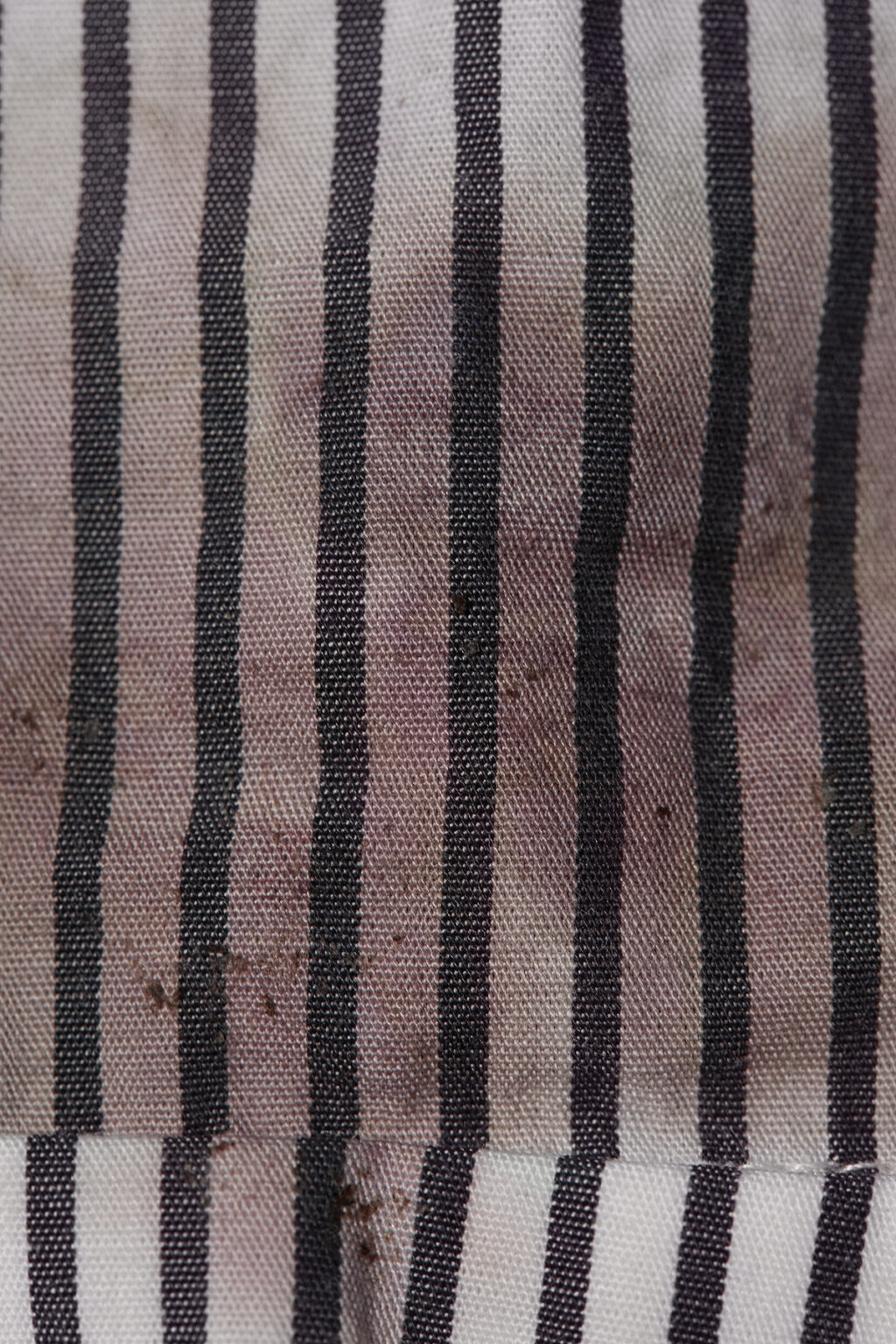
There are boundaries. I started making my own clothes in 2022. The other week, I finished a draped top of grey and blue broadstriped linen, the cloth cut on slight diagonals to make the stripes meander down across the body. It is made from two rectangles, one slightly larger than the other. A triangular trim of the excess fabric is then attached around the bottom hem, giving a slight train to the back. I like it.
The other weekend my husband was bored of chicken so I bought pork chops. I cooked them with kimchi. The butcher had chopped the meat in butch slabs, taxing to cut with knife and fork. My pork chop slipped right off the plate, onto my front.
The grease stains were awful. I took off the top and straight away washed it with Marseille soap flakes. The stain remained. My new handstitched top ruined! I washed it again. The grease was gone. As with the Balenciaga jacket, I have clear aesthetics of dirt.
The dirt I desire suggests, to me, alluring stories of what has been done in the garments. The dirt I shy from betrays humiliation, like my loss of control of the pork chop. Take a regular pair of pants. If there was a stain at the knee, that would suggest brave and arduous labour that occurred during their wear. If there was a stain at the crotch, it would suggest I had lost control of my bladder.

I have a belief that I’ve not worn the Balenciaga jacket since 2017. But, taking it out the closet now, there is a USB stick in its top pocket. On it are horrible and hard recordings of acid and techno, the kind I like to play at Chapter 10, the party I co-run in London. The digital information of the USB shows me that I added one of the tracks at 4.24pm on 9 January 2022. I must have overridden my shame at the stain and worn it out.
I want to give my poor Balenciaga jacket some attention, after all these years of neglect. At this moment, I am eagerly packing for my beloved Glastonbury Festival, where any garments worn face possible ruin. Days are often hot, and the party where I spend most of the nights, the NYC Downlow, is steamy. But another layer is needed for the cold dawn light. My stain can be at home among the soiled humans.
I have other pieces ready to be dirtied. From Simone Rocha, I got this season’s pale-pink ballet shoe for gentlemen, as seen in look 11. They are delicate little things, the pink satin held in pleats over the top of the foot, a criss-cross of pink elastic holding them in place, the shoe on a thin translucent tread.
I have yet to wear them, because they are too clean. This is a paradox. They need wearing for me to find them wearable. I will wear them in dust, in dancefloor grime, in foottreading crowd. And then in their dirt I will love them.