Glenn Martens
No filter

We’re in a restaurant in Milan – my personal favourite, A Santa Lucia – which feels a bit cosmopolitan and grand but also like a cosy home away from home, with the most amiable service. The chances are of course slim that one of the gentlemen at the tables around us would happen to be legendary designer Martin Margiela, but the question is nevertheless legitimate.
From Fantastic Man n° 41 — 2025
Text by GERT JONKERS
Photography by ILYA LIPKIN
Styling by ROBBIE SPENCER
Does Glenn Martens, Diesel’s creative director who in January this year was also announced as the new head of Maison Margiela, ever wonder whether Martin, a fellow Belgian whom he’s never met or spoken to and who never has his portrait taken other than, probably, for his passport, is that man sitting next to him at a bistro or in the metro? It’s not impossible, after all. Glenn lives in Paris, where, allegedly, Martin also still lives. “The possibility hasn’t crossed my mind, no,” says Glenn. “I’ve been meaning to write him a letter, though, if I find the time. Someone who knows him well told me the other day that Martin thought I was the best choice for Margiela, which I thought was very exciting. I hope I won’t disappoint him! Let’s see. But I think it’ll be fine.”
Glenn Martens and I met a few hours earlier, at his office in Diesel’s Milan headquarters. You’ve never seen a more boring office than Glenn’s. The lauded creative director at large of the billion-dollar denim imperium, who actually has a degree in interior design, has clearly not wasted one second of his time on decorating his work space. Also, five years into his role at Diesel, he spends less and less time in Italy – six days a month – so why bother? He flew in from Paris early this morning; his weekend bag is next to his desk and will be dragged along to our dinner later. He’s about to go into today’s final work meeting, so he asks his assistant, Paola, to take me around the adjacent showrooms. There, five minutes later, Glenn rejoins us. “That was a great meeting: quick and easy!” he says. The Diesel collections that we’re looking at are designed according to a strict brand bible that Glenn wrote five years ago when he got the job and was stuck at home because of Covid, so he had all the time in the world to formulate his ideas. The denim brand desperately needed redirection, and now everything that happens under Glenn’s guidance falls into one of three categories: “denim,” “pop” or “utility.” How that pans out may be unnecessary for customers to know, but it’s a strictness that works for Glenn and his team – a rigorous work methodology that he got accustomed to early on in his career, which we’ll get to talk about later. First, we’re taking the car to the restaurant. Glenn tells the incredible story of his aforementioned assistant, Paola, aged 61, who works part time at Diesel and spends a considerable amount of her spare time writing. “Which is perfect, because I also work only half the week for Diesel,” he says. Next week, Paola’s auto-fiction debut novel, part of a planned duology, will see the light of day through popular Italian publisher Mondadori. It would be unethical to share the astonishing details of Paola’s story as told by Glenn here in this car, if only because elements of it will only appear in future parts of her literary work. But it will be worth reading! Glenn has ordered 100 copies of the book to distribute among his team.
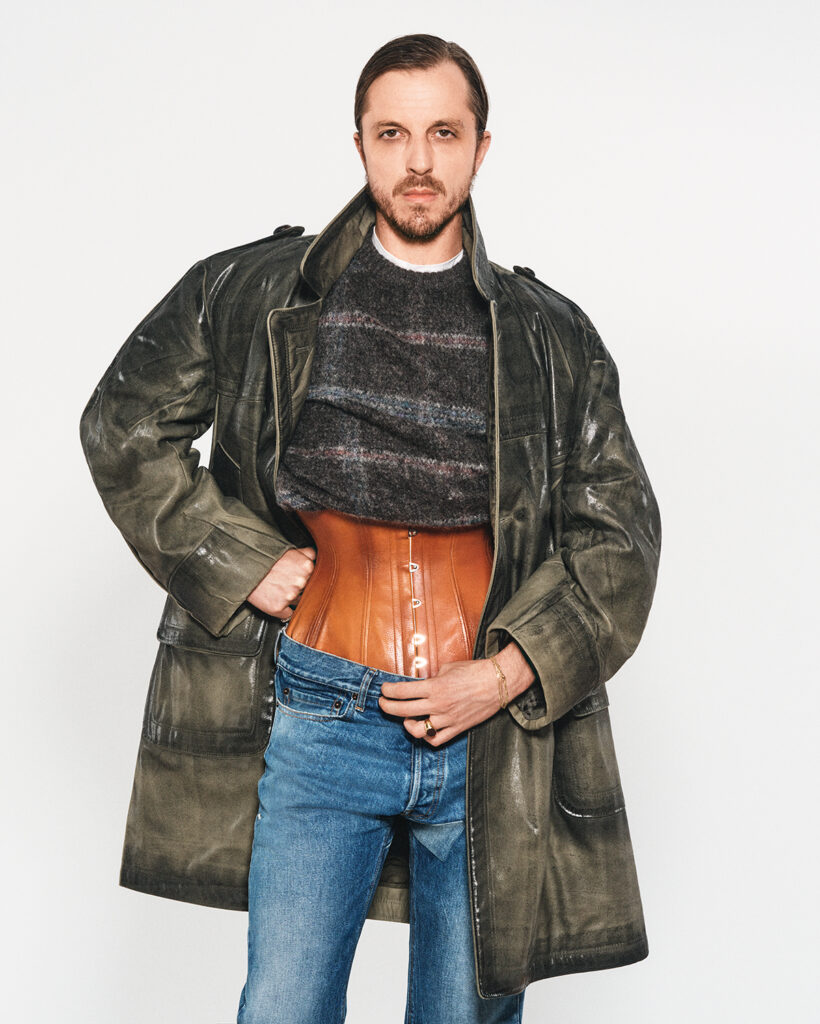
Glenn and I both speak Dutch as our mother tongue, but thanks to his social skills (we’ll get to that later too) he’s quick to figure out that I’m struggling with his quite peculiar accent – like many from Bruges, in north-west Belgium, he has a particularly distinct and unique way of pronouncing the Dutch language. “You don’t really understand what I’m saying, do you? Shall we switch to English?” Which is perfect for me, also because it saves me from having to translate our conversation. What also makes my job as an interviewer a breeze is that Glenn speaks in rapid-fire sentences, often asking the questions himself and then answering them. Throughout our dinner I just happily sit back, entertained by his vivacious monologues on everything from relationships and family to Margiela, dogs, the art of efficiency, Renzo Rosso (his boss) and “Y/P,” which is his parlance for Y/Project, the Parisian cult label that catapulted Glenn into stardom (and vice versa). Fascinating.
(GETTING TO KNOW EACH OTHER)
“So, Renzo, yes,” Glenn says. “I’m sure you know his story a bit. Don’t you? Diesel is like Renzo’s baby. His whole empire is built on Diesel. This guy is amazing. At the age of 20 or 21 he was a worker in a denim company called Moltex who set up this idea to bring out their own independent collection – as heads of factories often do when they’re suppliers for these other brands. Renzo, being young and cool, was, like, ‘put some studs here, some stitching there, pimp things up a little bit,’ and that tiny little sideline became super successful. Eventually it got so big that two or three years later Renzo bought out the other guy. He bought the whole factory, and the whole collection was his, and Diesel was born, in 1978. And now, almost 50 years later, thanks to Diesel, he has Only The Brave and the other 75 companies that you and I don’t know about. He owns so much. He owns buildings in Milan, he owns hospitals, he owns bio-farming companies, you have no idea.” (Besides Diesel, Only The Brave owns such brands as Marni, Maison Margiela, Viktor & Rolf, Jil Sander and part of Amiri.)
A Santa Lucia’s specials for today are written on a chalkboard on the wall behind Glenn. He turns his head around to try and decipher what’s on the menu, only to regret the gesture immediately. “Ouch, not great for my neck! I can’t do this.” Since his day job is filled with decision-making, he can’t actually be bothered to contemplate a restaurant’s offerings endlessly and allegedly always orders the steak frites whenever he can. That’s not on the menu here, but his eye lands on the spaghetti vongole – that’s it. For starters, we both order the boiled green asparagus, which arrives covered with a fried egg, sunny side up.
Glenn and Renzo first met in 2017 when Glenn won the Andam award – a prize for emerging fashion designers that the Diesel owner was on the jury of. He couldn’t actually take part in the judging for the prize so he sent his personal assistant instead. She fell in love with Glenn’s work and told her boss to meet him. He visited Glenn at his “tiny” office at Y/Project in Paris. One thing that caught Renzo’s attention was Y/Project’s abundant use of denim. “Which in fact I only used because it’s a cheap fabric that resembles the thick cotton that you make toiles in, the first stage of a design,” says Glenn. “Which was ideal for me, because as a starting designer I was very much into pattern making.” So while for Glenn the use of denim was a way to save costs, Renzo thought, “Glenn likes denim!” Glenn, however, had no interest in joining Diesel. “Definitely not. I was into design and creativity, not into making five-pocket jeans. Also, in 2017, Diesel was just such a tacky brand, dated, nobody in fashion cared about it, the average customer was above 45, straight, probably homophobic, probably sexist too. Male. Not really the dream company to work for when you’re a young designer. And back then, whenever I was thinking about a career, I was always thinking luxury, luxury, luxury! I had a lot of missed opportunities,” he says, laughing.
Indeed, for six months in 2018 it looked like conversations that Glenn was having with Versace about joining them for a top role were proceeding in the right direction. “I was so excited,” he says. “I think they’d been having conversations with Riccardo Tisci and Kim Jones, but both declined because they wanted to be their own boss and not have Donatella Versace staying on. So I’m sure they thought, ‘Let’s go for an unknown junior designer instead,’ and the first thing they asked me was how I would feel about having Donatella staying on. And I was, like, ‘Love it, love her!’ It’s like having your fairy godmother beside you every single day!” Glenn did a big “project” for Versace – fashion’s way of testing a new designer. But then, the brand got sold to Capri Holdings, the American conglomerate founded by Michael Kors, and the idea of hiring a new designer was off.
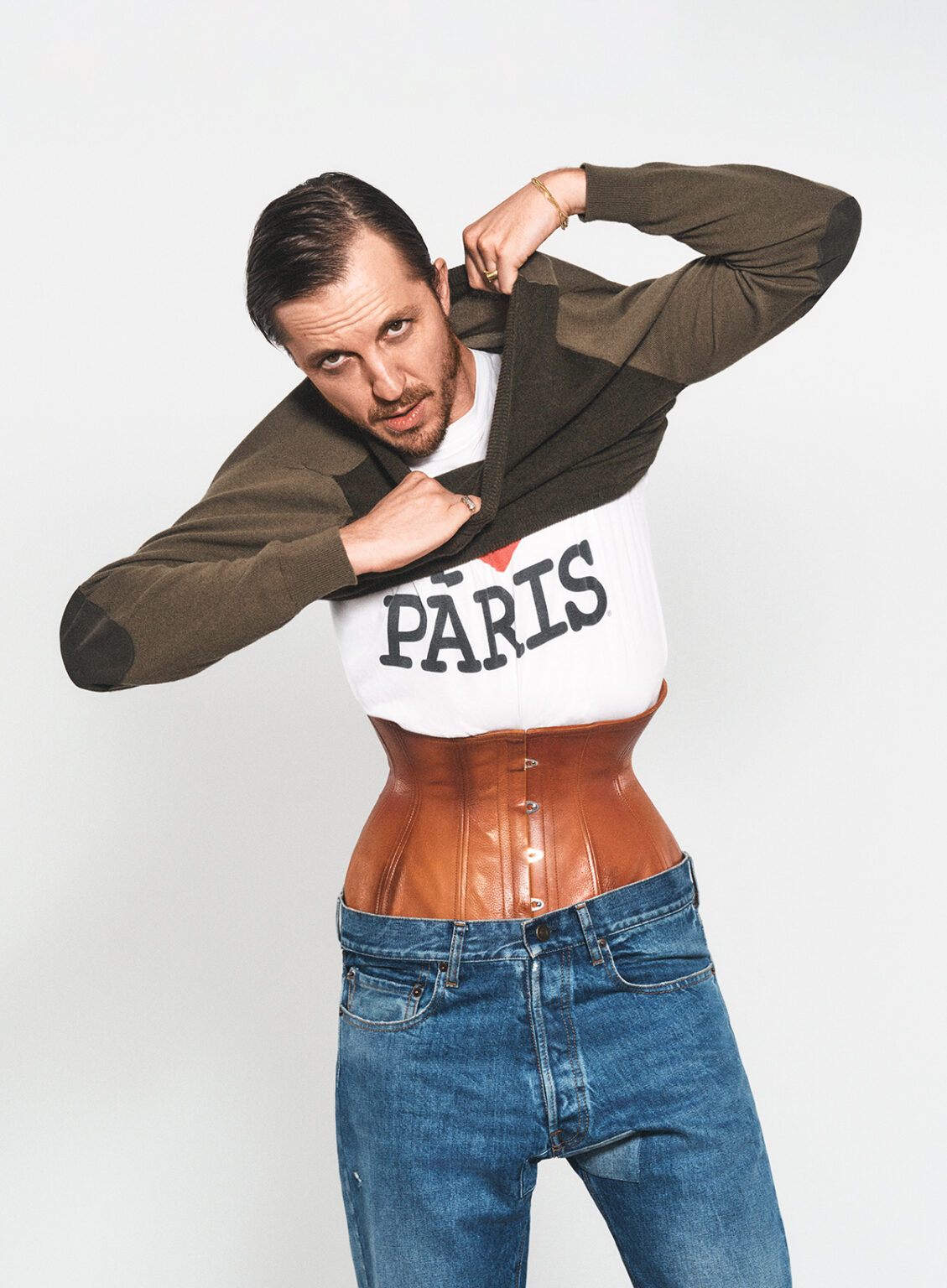
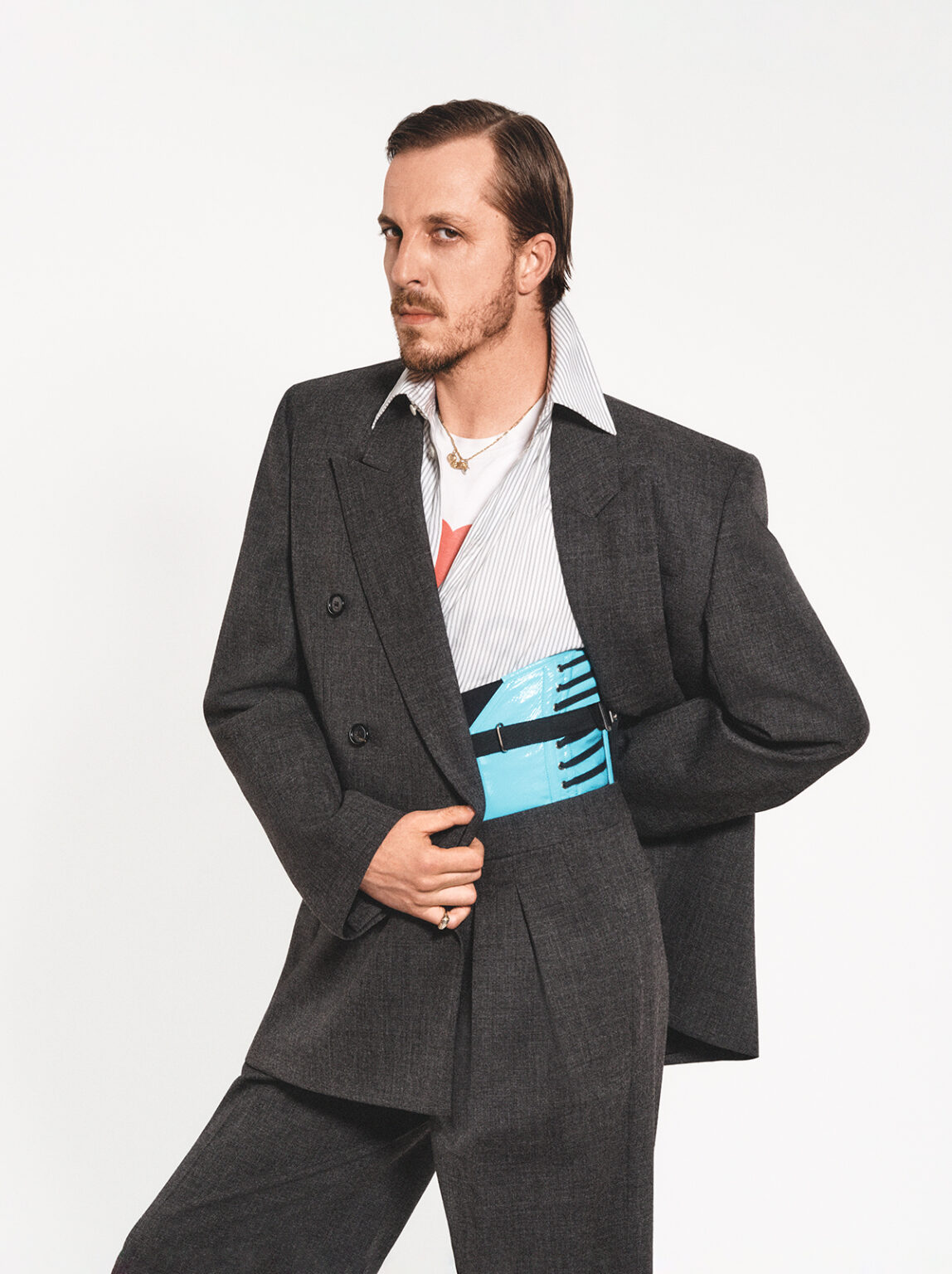
Glenn also did “projects” for Alaïa and Kenzo. For the latter he had the idea to channel founder Kenzo Takada’s roaming spirit and produce each collection somewhere far-flung, in a different part of the world, with the deep involvement of local graphic designers, print designers, craftsmen, pho¬tographers and models. LVMH didn’t go for it. “Meanwhile, this guy was insisting year after year, Diesel, Diesel, Diesel! So I was thinking about it. I had Y/Project, which was already, like, doing creative things all the time. I was creatively completely satisfied there; it was just like creative masturbating all the time, you know, because there was no real rule about making clothes, just freedom, and I thought, ‘Do I really want to do that again somewhere else but just with a different aesthetic, because maybe that’s not what I need right now.’ I would love to do something completely different, and the idea of doing a lifestyle brand with such an enormous reach and impact, talking to so many more people, where potentially you can accelerate some things to change, it felt more interesting.” Glenn finally joined Diesel in October 2020, while the world was in lockdown.
(DINNER IS READY)
“Renzo and I get along quite well. Very well actually,” he continues. “I think we have a very similar mentality.” His new boss had three main requests: make Diesel look young and cool again (“Gen Z, Gen Z, Gen Z!”), grow the womenswear department, where only ten per cent of the brand’s turnover was made and connect with China, where Diesel was pretty much non-existent. As one of his first moves, he sent around a manifesto to all the big shots at Diesel, of how he envisioned the brand’s social and ecological values. “That was a bit too extreme,” he says in retrospect. “I was so idealistic and junior, and so stupid. In a company like Diesel, you can’t take quick steps on sustainability if it raises the price of a pair of jeans by €10, and you can’t kill all the denim washes all at once. But the good thing was, Diesel had never had a creative director before who was responsible for literally everything that has a Diesel logo on it, so they took my word, as if I was Karl Lagerfeld and this was their new reality. I must say, I pushed things a lot. When I arrived, three per cent of our denim fibres were made of either organic or recycled cotton. Now we’re at over 50 per cent. Bon apetit.” Our spaghettis have arrived.
Next up in Glenn’s start at Diesel was his first ad campaign: for SS21. “This was obviously not for a collection I had worked on. I had to deal with this horrible collection full of fluo and studs and whatever, and I’m, like, ‘Okay guys, we’re not going to use these clothes.’” For his first Diesel campaign, they found eight couples, worldwide, who had been separated from each other for an amount of time due to Covid. They talked about their time apart, and they were photographed reunited, making out. “Nothing was spelled out, but you could feel it was mixed culture, mixed race, mixed sexes, mixed ages, some straight, some gay. And then the death threats started coming in, to me. Personal messages on Instagram with death threats, like, ‘We know where you live…’ So, this was my second month at Diesel, and I thought: ‘Ha! There’s a lot of work to do here!’ So yeah, I was really happy that I went to Diesel.”
This may read like a somewhat cynical remark on paper, but as far as I can tell Glenn doesn’t really do cynicism, and he’s actually thrilled that he found a job where he can move mountains. He sees Diesel as a big democracy, which is why their biannual fashion shows in Milan aren’t exclusive elite events but rather spectacles where audiences run in the thousands. Besides Glenn’s steps in making fun clothes (the Diesel shop is now quite full of them) and trying to phase out a line of extra-comfortable jeans called JoggJeans (“I can’t see how any Gen Z’er – or any other person who is even vaguely reliable —would want to buy a JoggJean; the name alone is dated”), he also got rid of Diesel’s classic emblem showing, in silhouette, the head of a man with a mohawk. “That emblem was born in the ’80s as a punk. But due to bad marketing decisions it got renamed as a Mohican in the late 2000s,” says Glenn. “I like it, it’s a sexy logo. But it’s called the Mohican, and do you know how Native Americans were treated in history? You cannot have that as your logo anymore. So I cancelled it. People were in shock. It’s like Matthieu Blazy walking into Chanel and saying: ‘Sorry, no camellias anymore, we’re cancelling the camellia.’” His boss Renzo argued that the original logo design, from the 1980s, was based on a punk in Camden – “But if you type ‘Diesel punk’ into Google, you get, like, three hits. With ‘Diesel Mohican’ you get 75 pages of hits. So that was that,” concludes Glenn.

(MIXING ROMANCE AND WORK)
Glenn studied interior design in Ghent, Belgium, and then went on to study fashion at Antwerp’s Royal Academy of Fine Arts. In his third year at the academy, he kindly volunteered as a fit model for the fourth year and got along really well with the group’s teacher, Bruno Pieters, a lauded designer who was showing in Paris and later worked as art director for Hugo Boss. “Then one night, after a party in Antwerp – it was a Diesel party, actually! – I took Bruno to my place and we started dating. Very illegal, of course, for a teacher and a student to date, so Bruno stopped teaching. He was my first big relationship.” Glenn started assisting Bruno on his label and for jobs at Weekday and Hugo Boss, learning everything about the day-to-day complexity of fashion. “Spreadsheets, collections, seasons, each drop has its mood board, bam bam bam! Structure is the answer! Through Bruno I became a creative consultant for Hugo Boss, which wasn’t creatively the most challenging situation, as much I as I like German food and a glass of beer, but it was very interesting as a young designer to understand the politics of this type of company. It really helped me for when I started my own brand, and for Y/Project, and surely also for Diesel, that I came in with this strict Flemish – or maybe German – way of thinking. My grandfather was a colonel in the Belgian army and my dad is a judge, so I definitely do have a kind of rigidness in my education. That helps.”
After graduating in 2008, Glenn moved to Paris. He worked for Jean Paul Gaultier and as an assistant to designer Yohan Serfaty, one of the founders of Y/Project, before launching his own label, Glenn Martens, which he kept afloat for three seasons. “The first one was good,” he says, “the second was shit, the third one… I mean, it’s really you in your tiny studio with two interns, cutting patterns, selling, doing PR, doing everything. Opening Ceremony was my biggest buyer, which was quite great. Not bad. But I have to say, I would have stopped anyway; I was so burned out after three seasons.”
When his former boss Serfaty suddenly passed away in 2013, Glenn was hired as creative director at Y/Project, where he steered the somewhat dark, gothic image (lots of washed leather) towards something thoroughly his own: a playground to have fun with clothes, like a sportswear Schiaparelli, or surrealism for millennials. Fashion fans loved Glenn’s Y/Project, and its atelier grew to dozens of brilliant designers, its shows a hot ticket of Paris Fashion Week. But when the other founder/owner, Gilles Elalouf, died a year ago, the company quickly unravelled and the CEO left. Glenn suggested Renzo Rosso should buy the label (“because as much as I love the communication part of Diesel, design wise I need a place to be crazy and creative – and I knew Renzo wanted to keep me happy”), but somehow that deal fell through, and Glenn announced his departure from Y/Project in September 2024. “Voilà. This was twelve years of my life, and I thought the end of Y/P would be the end of my life, somehow. I felt really bad for the team. I felt responsible for them like a father figure. I did feel like I failed them.” Funnily enough, the team thought a bit the same. As Glenn’s farewell gift they gave him a dog. “They were, like, ‘You took care of us for twelve years, now you can take care of a dog for twelve years.’ Wow! I know nothing about dogs. The thing with a dog is, it really keeps you fucking busy from morning till night. It’s so cute.”
The dog is a border terrier called Murphy. A male, I presume? “For the moment, I guess so,” says Glenn. “But of course they have to choose for themselves, and you have to be patient, you know? You just don’t know if Murphy thinks they’re a man or a woman.”
There’s been a lot of change in Glenn’s world lately. He bought a country house, two hours from Paris – he describes it as a “mini chateau” and photos on his phone indeed show something super adorable with castle-like features. It’s from the 15th century and is currently uninhabitable – when he goes he stays in a little cabin on the site. He got the keys last January, and he went and stayed there immediately. “No lights, no heating, no hot water – it’s in the middle of nowhere. My boyfriend couldn’t come along because it was fashion week and he works in fashion; he’s head of graphics at Kenzo. I was trying to figure out how to make a fire, heating up with what wood I could find in the forest. I didn’t shower for days, I’m covered in soot from the fire, scratches all over from crawling through the forest, and on my way back to Paris, at 8.30 in the evening, my lawyer calls and says: ‘You have to stop now, wherever you are, and sign the Margiela contract.’” Ever since his Y/Project departure, if not before, discussions had been underway for Glenn to succeed the legendary John Galliano at Margiela, but the process had been caught in months of endless legal wrangling. The phone call meant a breakthrough had finally been reached and needed to be acted upon swiftly. So Glenn pulled in at a motorway Burger King, signed, and the next morning, at 10am, he started as the new creative director at Maison Margiela, one of fashion’s most radical and revered houses ever.
“There’s a lot to do at Margiela,” says Glenn of his new task. His predecessor, John Galliano, was amazing in terms of luxury and storytelling, he thinks, but never really thought what it would be to have a simple jacket or a nice day dress. “It was really good for the brand to have John and be so creative. I mean, I’m creative too; that’s also why Renzo asked me. But I also love to sell a sexy pair of pants.”

Glenn does look at the entire archive of Margiela but also finds that the defining Martin Margiela years have been copied so much now, one-to-one, by so many brands (“big brands, young brands, big designers, young designers, I’m not going to list them, but I mean, everybody knows”). Every fashion school does Martin Margiela-ish projects, elevating clothes, finding alternatives. “Even if they don’t call it that literally, it’s all based on Martin’s principles and DNA of the brand. Martin is, in my opinion, the most genius designer of all time. He changed the way we look at fashion, and from a kind of conceptual niche it became quite a common language that has been milked, and used, and seen, and appropriated all around.” Of course, Glenn himself is also a “kid of Martin Margiela,” and he hopes to reconnect the brand with the rawness of Martin and its hot and sexy and unique casting. “I have to find my way in. It can take me a bit of time to get a grip on it. It’s going to be an uitdaging.” Glenn delights in that Dutch word for challenge. “I always love an uitdaging!” he adds.
Renzo Rosso requested that Glenn start his tenure at the house with an “artisanal,” or couture, collection – why not start at the top? It’s an exciting prospect but he also has big boots to fill. “As much as I’m super humbled and honoured to come after John Galliano, he’s also one of the biggest couturiers alive,” Glenn says. “There’s no denying that John’s last couture show for Margiela was the best couture collection of the decade, and has touched everybody who saw it, including me.”
Because it was deemed not very chic to work with Galliano’s atelier while the designer was still at the house, Glenn booked a hotel in Venice for the Christmas holiday to work on the collection. Then, back in Belgium, his beloved grandfather, the army colonel, died. “He was 100 years old, bless him. We were just really happy that he lived that long. But we were heartbroken for my grandmother, who’s the most amazing woman ever, and who had been with him for, like, 84 years, sleeping together every night. So we all flew back home to spend two weeks with her, and I took that time to draw the whole Margiela collection, at my brother’s place, in Bruges, super silent, Christmas time, really nice. So, if nobody likes the collection in July, I’m the one to blame.”
(MESSY SON)
Fast forward to the show, in Paris, 9 July 2025. Glenn has found a brilliant soft spot between classic Martinisms – plastic, paper, paint, vintage jeans and T-shirts – and his own fascination for gothic architecture, corsetry and crazy shimmering ballgowns. The audience loves it – along with the happy vibe around the show. When we leave the venue, the Margiela team – at least a hundred – in their white lab coats, forms a guard of honour, giving us in the audience a standing ovation. It’s the world upside down. Post-show, drinks are served in a space filled with 27,000 coloured balloons, like a blown-up kids’ playground. As if he’s saying, here’s where the fun starts.
In the little smoking area outside, Glenn is greeted by his dad and stepmum (his parents divorced when he was young). Mr. Martens, the retired judge, seems like a jovial father. He says he always trusted his son’s fashion instincts, and by the way, he himself wore Diesel jeans long before his son’s affiliation with the brand. “But I’ll tell you one thing,” says Mr. Martens. “Glenn was messy. He’d always throw his clothes on the floor – his room was chaos, and I did not like that. So one day I said, ‘From now on, every garment that’s on the floor will be thrown out the window.’ And I did just that, the next day. It all went out flying! Never happened again.”
Glenn remembers the lesson but says, “I’m still messy.”
That might be true, but he’s also very organised. Back in Milan, at our dinner, he takes me through his agenda for the day, from a meeting about store exterior designs, to a review of an upcoming collaboration, production issues, a look at a collection of rucksacks for Japanese school kids, sunglasses with Luxottica, watches with Fossil, sportswear, underwear, perfume, etcetera. Tomorrow they’re doing fittings. “They’re intense, because it’s a huge collection. I don’t know how many SKUs we have, my PR can tell you. We fit seven models at the same time – three boys, four girls, constantly fitting in groups. Ra ta ta ta ta. At the end of the day I’ll have a migraine.”
Glenn thinks it’s quite funny that a new designer whom he hired at Diesel told him that she’d heard two types of stories: that Glenn is a nightmare to work with, and that he’s fantastic to work with. “I like that, to keep the mystery alive,” he says, laughing. “I think I’m very demanding, for sure. I put the bar high, also for myself. I work hard. I’ve never missed a flight, I’m always there on time. But I’m not always so patient. If I have to repeat myself three times, I get annoyed – the third repetition is one too many, and I become passive aggressive, and that’s the worst. I’m bossy. I’m very directional. But I like a round-table discussion and I love working with a team. Getting to know a new team is quite a sexy dance; it’s a bit like courting each other. I think it’s really cute.”
One perplexing thing Glenn says towards the end of our conversation, after we’ve had the dessert and the almond cookies and the limoncello, is that he credits much of his career to his insecurity complex. “You’re surprised? Well, because I’m very good at what I’m doing. But I think I reached that level because of my insecurity. I’m always thinking: ‘Am I funny enough? Am I sexy enough? Am I whatever enough?’ That’s why I think I jump into my work so wholeheartedly, so that I don’t have to think these things.” It also sounds a bit like something he said earlier, when I asked him if the pressure of the work keeps him awake at night? “Never. I’m too tired for that.”

His auto-analysis continues: “I very clearly know where I want to go. I’m very stubborn and rational and I always think ahead. I always have a plan A, B and C. I always try to anticipate all the problems that could occur. That’s probably thanks to my grandfather, the colonel, who was always asking, ‘What’s your plan B and C and D?’ And then my dad being a judge… On the other hand, I’m good at psychology and I’m good at reading emotions. I can quickly tell when people are bullshitting me, and then I just flip out. My mother was a very complicated woman who didn’t easily hand out compliments, but she would always praise my emotional intelligence. That was one of the only compliments she’d give me, so that makes me think she meant it. She even wrote it in her farewell letter – she took her life two years ago. Which I’m still digesting. It was a very strange week: we had 7000 people raving at the Diesel show in Milan and a week later we did the final Y/Project show in Paris, and her funeral was in between the two. But that’s not really interesting for Fantastic Man, is it? All I want to say is that I think this combination of reading people and being structured is a good combination for doing what I do. It works. Combined with a bit of creativity and a bit of luck.”
His couture debut for Maison Margiela makes one extra curious about his plans for ready-to-wear. His current ambitions for Diesel are simple: “It’s right on track to where it needs to be,” he says. They’ve been developing a process to make 100 per cent recycled denim, which he says is a breakthrough, and they’re working on a list of other advancements. “For successful living,” he says, quoting the brand’s tag line. “I feel like that describes me quite accurately as well. I love it here.” He recently signed his contract for five more years at Diesel – he happily continues to combine it with his role at Margiela. “I think those will be my last five years at Diesel. After that, I’ll be too old to still want to design for Gen Z. I mean, my rave days are over. My ketamine days are over. You can’t go on forever, can you?”
He also has a Glenn Martens x H&M collection out soon, in November. The amount of work! “You know what’s the best thing about having a dog and the new country house?” he says. “It’s the only thing my boyfriend and I talk about at the end of the day. We never discuss work anymore. So much better.”
Photographic assistance by Marlee Pasinetti and Hugo Varaldi. Digital operation by Christoph Stieber. Styling assistance by Isabella Damazio and Robbie van Mierlo. Grooming by Matt Mulhall at Streeters. Production by Company.