Piergiorgio Del Moro
Casting by
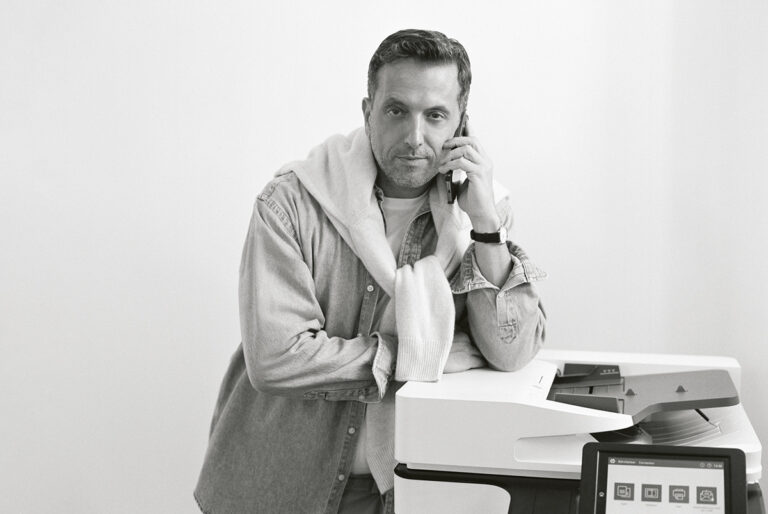
The super operator who knits together the world of fashion like no one else.
From Fantastic Man n° 41 — 2025
Text by CAROLINE ROUX
Photography by BRUNO STAUB
Styling by JULIAN GANIO
On a hot day in June, a young model called Amos got his big break: opening the Dries Van Noten menswear show in Paris. Beneath the arched glass and concrete roof of an old industrial hangar, he strode out in a short, high-collared mac, accessorised with bright-red socks and trainers. “He set the whole tone of the casting,” says Piergiorgio Del Moro of the slender, solemn boy when we catch up on the phone after the show. “He’s a brand-new kid, still at school.”
Amos had come to Del Moro’s attention thanks to his agency, Rapture, who had just signed the 18-year-old. But as a casting director, Del Moro has to search far and wide to fulfil the desires of his clients, matching faces to brands for designers’ runway shows and campaigns and finding the right fit for editorial shoots. “It is my job to be in the middle, between the client and the model agency,” says Del Moro. “In the 1980s or ’90s there were only 50 or 60 models to look at, and the designers and stylists and editors could make the selection. But now there are 5000, and they need someone to filter them.”
Del Moro, though, is hardly just someone. “He’s the best, the number one,” says Carine Roitfeld, who has worked with him for over 15 years, first on the fund-raising fashion shows for amfAR, then on the launch of her magazine, ‘CR Fashion Book’. It was Del Moro who introduced Roitfeld to Gigi Hadid, which led to the young Los Angeleno’s first cover on ‘CR Fashion Book’, in 2014. In the same year, the pair cast her in a Tom Ford Eyewear campaign with Patrick Schwarzenegger: a star was born.
“He has an incredible eye,” says Donatella Versace, who relied on Del Moro to reassemble the 1990s supermodels for her tribute to her brother in 2017, marking the 20th anniversary of his death. “That broke the internet. But he’s always understood the Versace aesthetic. A Versace model has to have presence, power and beauty of course. But also a really strong attitude. A great model makes the clothes come alive, and Piergiorgio really understands that.”
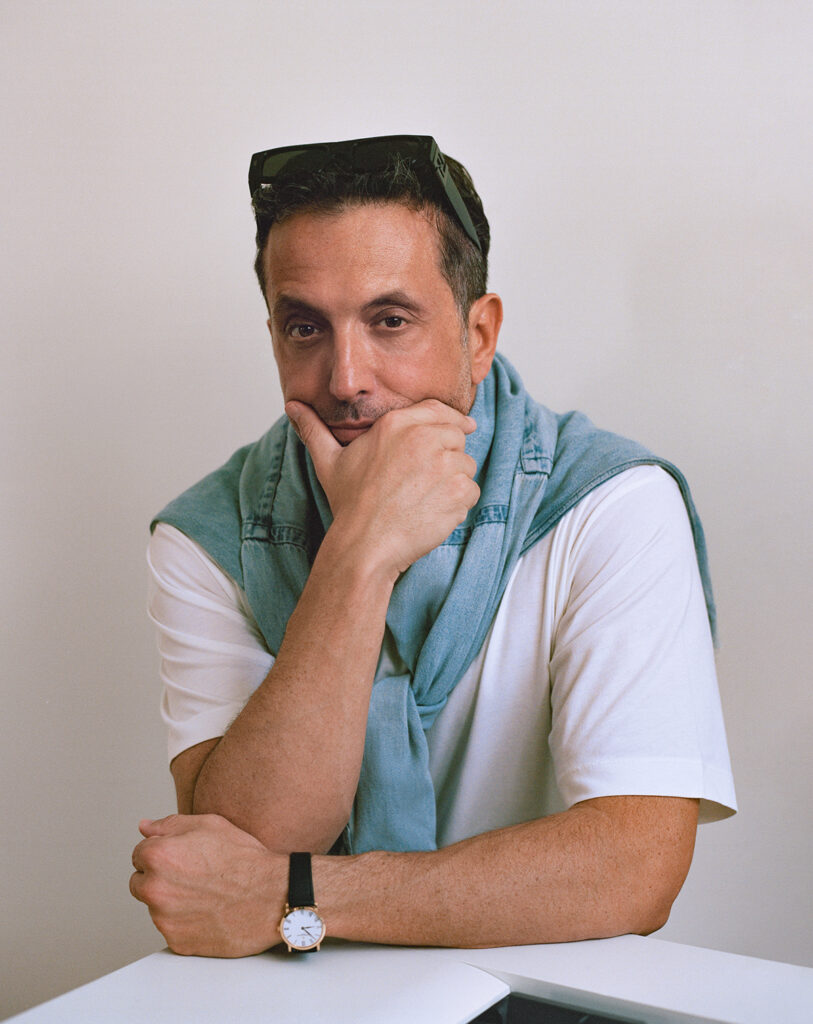
On another day, earlier in June, I went to watch Del Moro at work. The occasion was a pre-casting for the coming menswear shows in a hired studio in the 11th arrondissement of Paris. Two young women sat at a desk, set up temporarily at the entrance of the ground-floor space, signing in tall, skinny young men, one after the other. At the end of the room, a handsome, sandy-haired twenty-something was taking pictures of each new arrival. (Marco, it turned out, had been a model himself.)
To one side, a mini runway had been set up and five of Del Moro’s team, from his company, DM Casting, sat behind tables, their eyes firmly focused on each candidate as he walked back and forth, some of them for the first time in their lives. Enzo, aged 20, was sent to the washroom to put water on his thick fringe in order to push it back from his face. “You need to see what they really look like,” said Del Moro, who was also there. Most of the boys wore trainers and had long, loping gaits. One, Stefan, had clearly practised the piercing, forward gaze of the seasoned model, but turned it into a menacing stare. A Brit, Tom, had worn loafers and sashayed with some style. “Your friend is a fashion designer, yes?” asked one of the team. Each had a minute at most to prove his worth.
“Sometimes they walk once, and you can tell immediately if it’s going to work, or not. I focus on body language. It’s all there. But the pictures are equally important,” says Del Moro when we move to an upstairs room, empty but for a sofa. “I like it when they are spontaneous and natural. Some have been briefed by the agency on how to stand and carry themselves. But today there was a guy who stopped at the end of his walk and posed with his hand in his pocket. It looked like something from the 1990s; I think he’d been trained by his father.”
After this initial trawl, a more finessed casting will be held at which the creative director will also be present. “That’s the second step, when we bring in the client,” says his right-hand woman, Giulia Massullo, a 38-year-old from Rome who has been by Del Moro’s side for twelve years. “It takes a lot longer, a couple of hours. They might want a boy to try on a jacket, to see if the look works with their body.” Occasionally a model will get rejected even further down the line. “If it’s not working out, and you have to cancel someone from a project, it’s not nice,” says Giulia. “We’re working with human beings after all.”
On this occasion Del Moro was looking for models for Tom Ford, Dries Van Noten, Dolce & Gabbana and AMI. “I’ll send the one with the bright-red hair to Tom Ford,” says Del Moro of a boy from earlier. “He loves a redhead.” His success – past and present – has always depended heavily on his close relationships to creative directors. “Donatella, Tom Ford, Karl, Ralph Lauren, Dries… I love those big iconic people,” he says. He has worked with Haider Ackermann, now at Tom Ford, since the designer’s Berluti days (2016–2018), and describes him fondly as a real gentleman. “His first show for Tom Ford was done from the heart,” he says, where the casting included model-turned-photographer Ethan James Green.
“You must really get to know the designer and start to understand how they work and what they like. I am the filter. It is about fitting the person to the project,” continues Del Moro. “They will send me references and images, mood boards, movie stills – all sorts of material. Then we begin to look at the collection and see how the clothes are developing. The casting evolves as the collection evolves; you begin to see what’s needed physically to show the clothes. If the collection is inspired by a writer, for example, or has a title like ‘the eclectic woman,’ then you start to think about what matches that vibe. You might have a favourite model who just doesn’t work for that collection, however much you love them.” Jacquemus, for example, who was showing his Provençal-inspired collection at Versailles, was after a healthy look. Several of the male models that Del Moro chose had deep tans and their sleeveless tops showed off keenly worked-out arms.
When Peter Copping picked up the creative reins at Lanvin last June, he called upon Del Moro for his first show. “We wanted the cast to be multigenerational and Piergiorgio really got onto that. He called obscure agencies and got people out of retirement,” says Copping, who had already lined up the 54-year-old Daniel de la Falaise, who now works as a private chef. “He has such great personal style.” Copping describes the Lanvin man as “cool and sophisticated. I’d say the guys have to be pretty tall and skinny, but not emaciated. It’s a body type where the clothes hang nicely.”
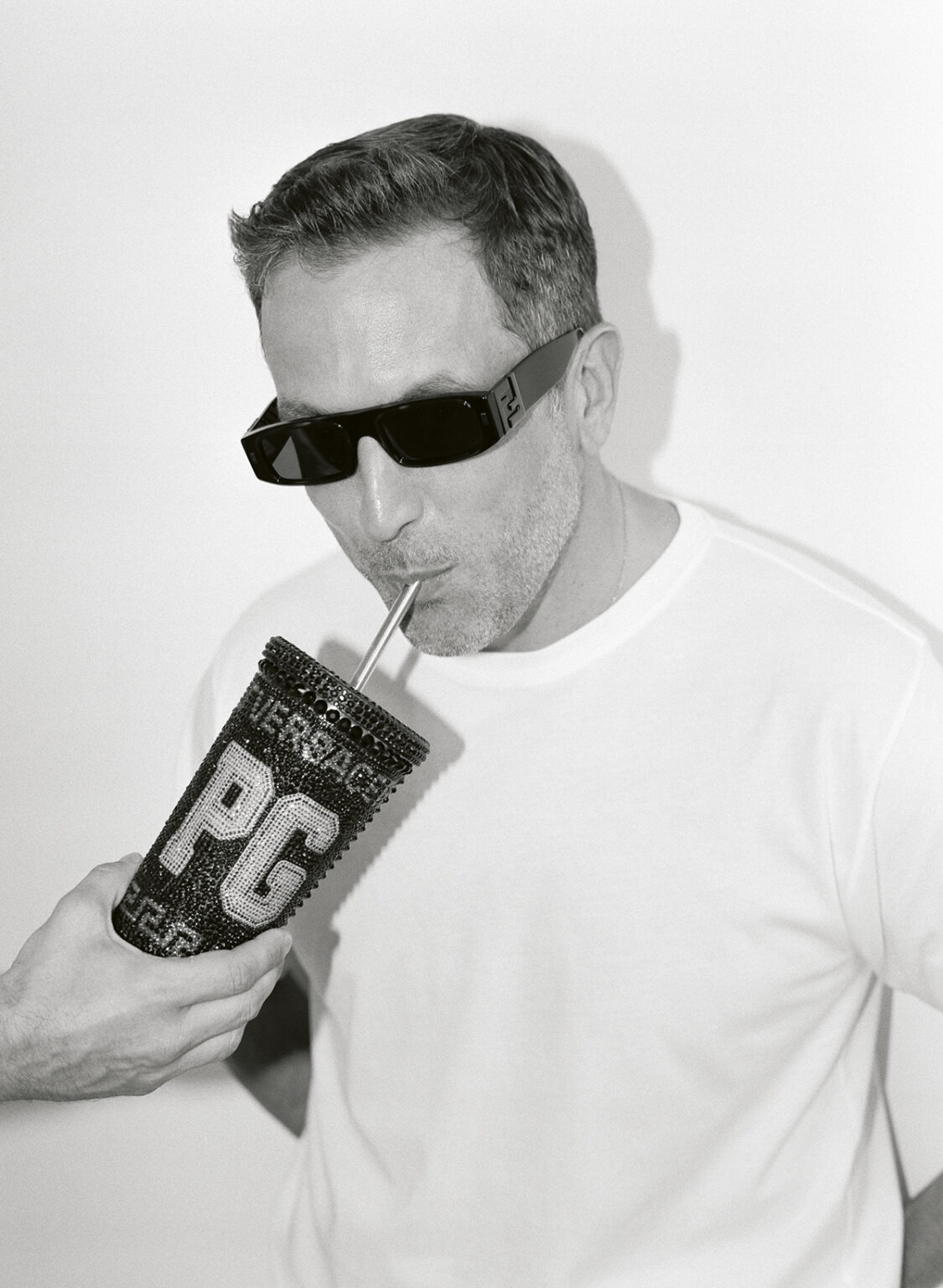
Del Moro never wanted to be in front of the camera himself. “I belong behind the scenes,” says Del Moro as we settle into our conversation, his phone hotly pinging. One call has to be answered: a model can’t make it to a shoot because she has an exam that day. He seems unfazed by the unravelling disaster and puts the phone face down. He is dressed in his work uniform: white T-shirt, casual Ralph Lauren trousers and Sacai x Nike trainers. Today the trousers are bleu de travail, but he also wears them in beige and white and is having a black pair copied by a tailor. “I need to be comfortable,” he says. He is blessed, at 48, with a thick head of hair which is looked after by Guido Palau’s assistant, Sandy Hullett. “It gets really long in fashion weeks, because I can’t get near her,” he says.
It turns out that he was, in his words, “a chubby child,” though now a better description would be tall, dark and fit. “I still struggle to find the right shape – I’m Eeeetaalian, I love eeeeating,” he says, his strong accent joyfully extending the vowels. “But I do weights three to four times a week and it works for me.” Just don’t mention cardio. “I hate it!” He likes to cook at home – an elegant apartment in St. Germain that he moved into several months ago and that was decorated by interior designer Gabriel Coin. “I like to be somewhere with clean lines and strong colours,” he says, showing me a picture of a sitting room with fine parquet and large sofas upholstered in dark-olive mohair. “It’s a work in progress. I want to put in lots of bookshelves.” The kitchen is all marble and Miele machines. “My favourite recipe is a good spaghetti al pomodoro, where the sauce is cooked slowly and for some time on a gentle heat,” he says.
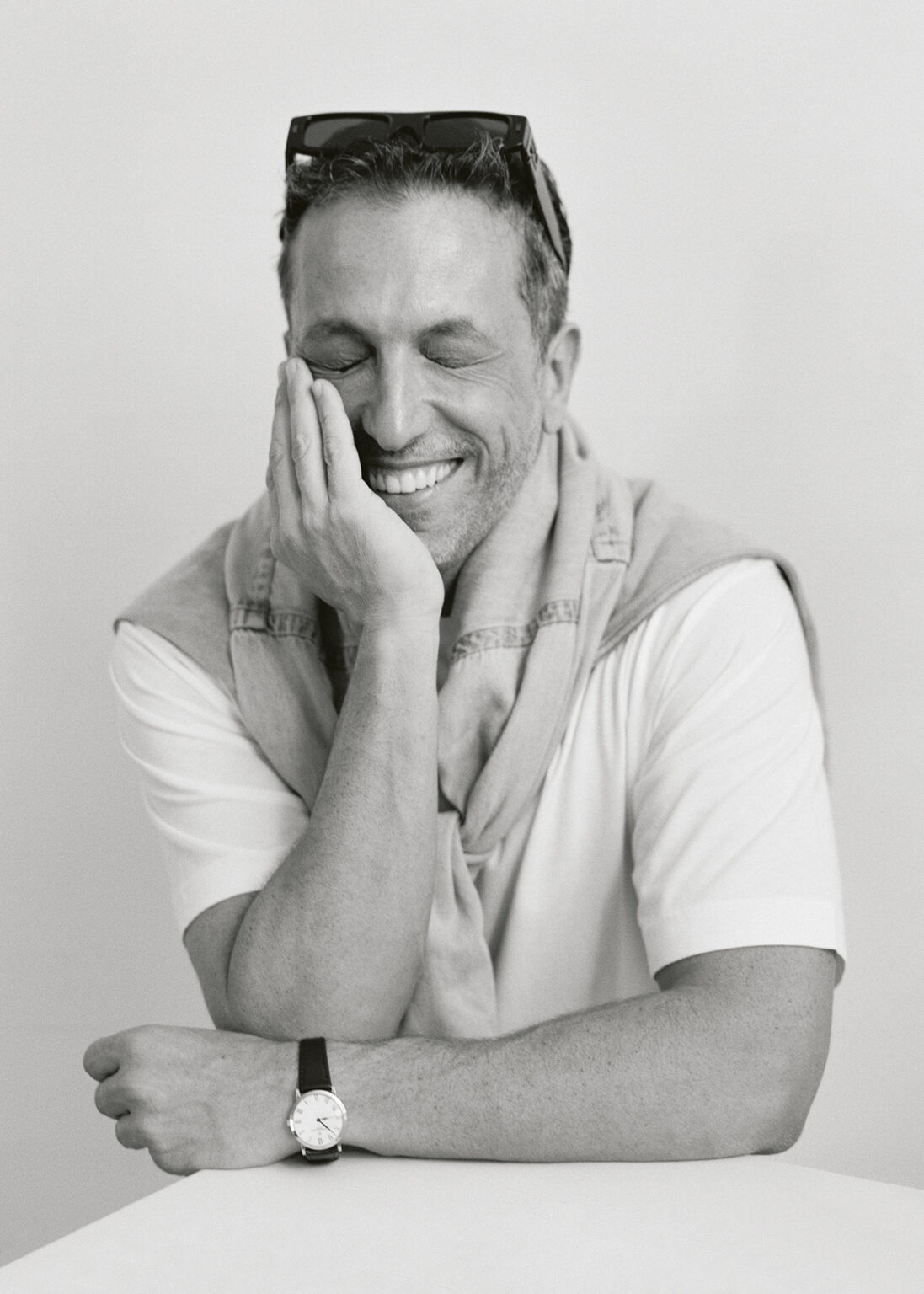
Born in the seaside town of San Benedetto Del Tronto in 1977, Del Moro grew up in a glamorous household. His father, Mimmo, was a television impresario and talent agent who worked with Italian superstars such as Raffaella Carrà and was heavily involved in the Miss Italia contest. “It was the biggest show in Italy,” says Del Moro. “I grew up surrounded by beauty. But beauty was just one thing in those days: one age, one type. Now it’s all sorts of different people, and my job is to see what happens in the street and reflect that on the runway and the pages of magazines. It doesn’t need to be about diversity, but a more fluid conversation about how society is changing and developing.” He has worked often with what he calls the “curvy girls” – “Ashley Graham in a bikini is the most sexy woman on the planet,” he says – and he was instrumental in the rise of Alex Consani. “She is the first trans model to become really famous,” he says. “The first shows she did were Tom Ford and Versace.”
Although he studied law at university, he didn’t finish the course. Instead, he started working as a producer, taking multi-brand Italian fashion shows to Asia, in an initiative financed by the Italian Department of Foreign Commerce. “It was very difficult in Japan,” he says. “The old guys in production didn’t much like this young man from Italy.” So, by his early thirties he was in New York, living in the West Village, partying at the Limelight (it was the late ’00s) and running a small production company. “I decided to focus on fashion production and then I kept hearing people talking about casting all the time,” he says.
Though there were already professionals out there – the Brit Russell Marsh, the Korean American Michelle Lee – Del Moro took a fearless approach. “It was what I wanted to do and I was determined,” he says. “I worked on projects for free. I still do if it helps a young designer.” In the early days, on a story for ‘V Magazine’ with British photographer Jamie Hawkesworth, he set off to a high school in Washington DC on a scouting mission. “It was one of his first stories. Jamie picked the school and I did the rest, sorting out release forms, convincing people. I paid my own expenses and stayed two days to cast the models,” he recalls. “It was quite risky. You could get punched in the face by the kids.”
Indeed. Back then, many young men didn’t know what modelling was. “They had no idea what you were asking them to do. They could get offended,” says Del Moro. “Social media has changed everything. It has given the whole profession more exposure.” Though he rarely engages in street casting, he says that the agencies spend hours on TikTok and Instagram, and music festivals and concerts are also known to be fertile territory. “You see people looking good, having fun,” he says. “Though I don’t go to festivals. I like a concert where I can sit down.”
He went to one recently, to see Beyoncé in London on her ‘Cowboy Carter’ tour. With him were Angelina Kendall and Natasha Poly. “Two of our Versace girls, whom we both love,” says Donatella, who was part of this fashionable gathering. “It was a very special night, with Mert Alas and other good friends.” This is Del Moro’s crowd – people at the top of the fashion game. “But I have a private life,” he says, “friends who aren’t related to fashion, and a great family.” He opts to not divulge too much about his love life but notes he is currently single.
Del Moro’s reputation as a man of big ambition might have earned him some enemies in the tricky world of fashion. He is known as a fairly uncompromising player in a field that is not without competition. Other casting majors include Ashley Brokaw, for example, who started her career with Bruce Weber and now works with Loewe, Dior and Vuitton, and Julia Lange, who works with Hermès. But his ability to get what he wants has earned him friends, too. Del Moro is known for being able to raise the top girls, all the time. “He has a lot of power, and that is important in fashion,” says Roitfeld. “It means you can get what you want and do the best shows and shoots with the best people. You call the shots.” His success, continues Roitfeld, is down to hard work and extreme charm, as well as to a ruthless streak. “He’s very smart and he’s sexy and fun,” she says. “Tom [Ford] really likes him, and it’s very difficult to seduce Tom.”
Del Moro himself puts his success down to discretion. “I have a staff of 15,” he says of his team, which is spread between Paris, Rome and New York. “And we go from one brand to another. You have to be a hundred per cent discreet. If my clients mind me working with other people, they don’t tell me.” His work rate is phenomenal. The following weeks will include ten castings, all for menswear, the Schiaparelli couture show, and all the fashion stories for Edward Enninful’s new magazine, launching in September: ‘72’ (“I’ve signed an NDA.”) “I sleep ten hours a night,” he says. “I don’t party much anymore.”
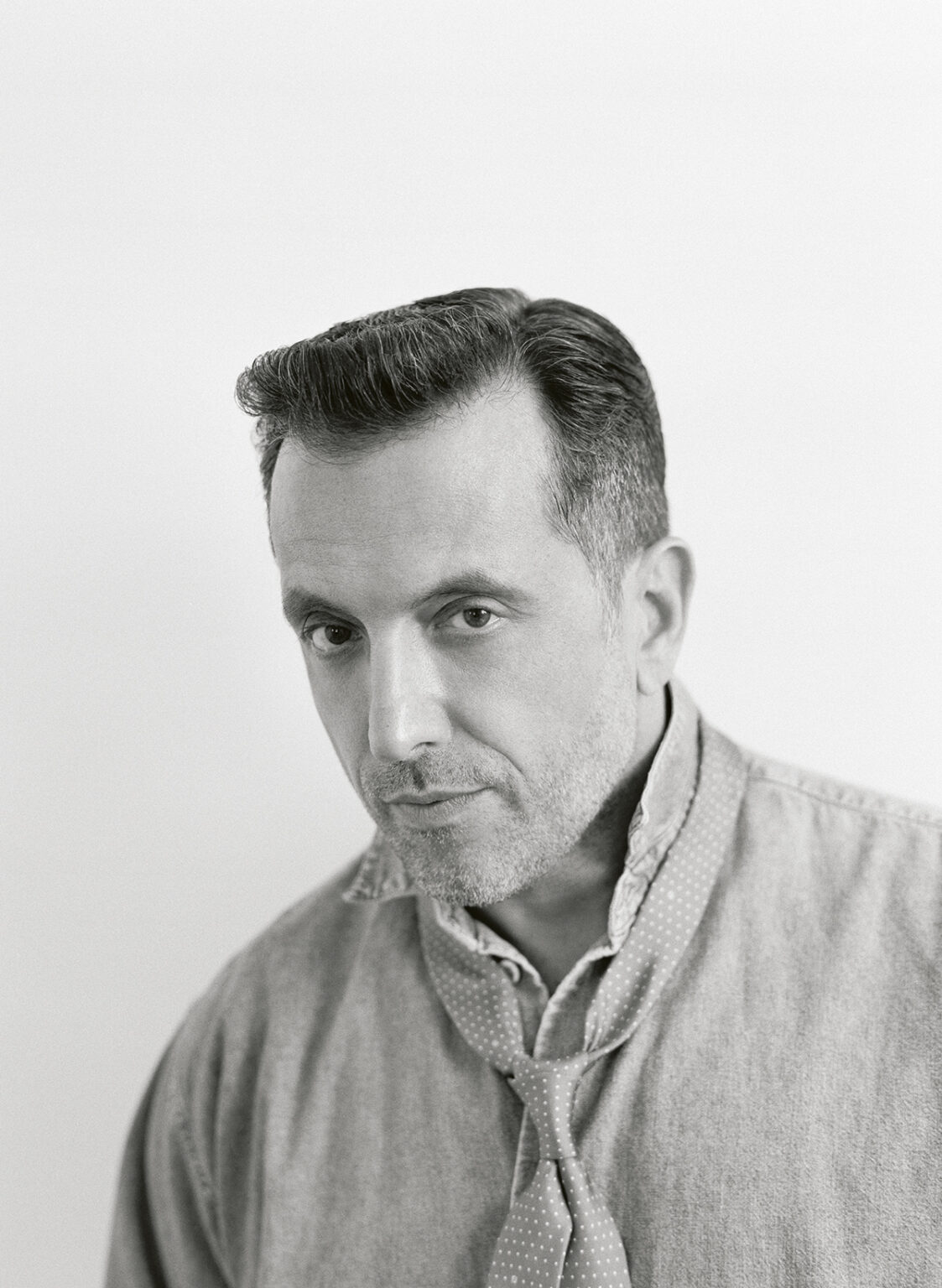
So what, I ask Del Moro, does he look for in a male model? “For the boys, it’s often in the smile,” he says. “Take someone like Clément Chabernaud. He’s very sexy and will always be in the business. He never changes. He’s always the same shape, the same beauty, the same elegance. And he’s a fun guy. He probably used to be a party boy when he was younger, but even then he was always on time, always fresh, and nice.”
Chabernaud is one type of handsome: a long, elegant face with strong, masculine features and deep-set eyes. Another is Leon Dame, the expressive walker who made his mark in 2019, aged 20, at the Margiela show when he ripped up the runway in a black leather mini trench and conical hat and some wryly exaggerated posing. Dame is full-lipped and large-eyed and can cut an androgynous figure even at 1.88m. “He has a real sense of humour, and that’s always a good look,” says Del Moro. “You can see that in someone’s eyes, so I tend to look there first.” He also mentions the hard-to-define quality of individuality. “Maybe it’s just someone who does their own haircut, and it looks great,” he says.
“When I started out, it was all about men with big frames, a big structure, in the old Versace and Calvin Klein days,” he says, referring to a history of preferred male body types that moved from the emaciation of 1990s grunge to the beefcakes preferred by Bruce Weber and Abercrombie in the 2000s (Del Moro worked with both), to a more uniform, long-legged, slender body type. “It’s pretty unified at the moment. But sometimes the boys are too skinny,” he says. He never gives a direct comment to a model. “I will pass my thoughts on to the agent, and I try to give my point of view in a delicate way. But they have chosen to be models. They will have to face critiques and not being asked back.”
Indeed, the male model’s lot is not an easy one. Chabernaud, who is still working at 35, is an exception. Careers are generally short. “Men’s fashion is very fast,” says Giulia Massullo. “It’s very much about new faces. So, they might do two or four seasons, but after that we’ll be looking for other people.” They are also paid considerably less than their female counterparts – a reflection of the different economic value of men’s and women’s fashion. “The money invested in women’s fashion is at a completely different scale, as are the profits to be made,” says Del Moro.
“It’s something we talk about all the time, how much less we are paid,” says Malick Bodian, a 28-year-old Senegalese with a sensational profile and sharp, high cheekbones, when we catch up over the phone. Bodian was scouted at the age of 19 when he was living in Corsica, and shortly afterwards was given his first ‘L’Uomo Vogue’ cover thanks to Del Moro, who had also booked one of his early shows, for Berluti in 2018. “I had no idea why I’d been asked to model,” says Bodian. “I didn’t feel beautiful. But then I began to realise that skinny boys like me were the look people wanted.” His very first runway was for Valentino. “I was terrorised. I just followed the other models,” he says. “But I’m an ambitious person, so I took it seriously and watched back my videos and progressed. And Piergiorgio helped me. He doesn’t just make you into a model and then leave you to it. He kept on making things happen.”
Bodian was always aware, nonetheless, that modelling is a temporary career for a man. “The female model is here to be a star,” he says. “Though I think more boys are thinking it could take them somewhere. Personally, it gave me confidence. And it’s important to realise the power of your physical self.” Bodian has now moved behind the camera as a fashion photographer and is also working on a script for his first feature film.
Now Del Moro is set for a busy autumn. There will be editorial shoots for publications, campaigns for brands and the casting extremities of the SS26 womenswear shows. “It is tiring and you’re continually working with big personalities,” he says. “But I’m so passionate about the business that I can manage. And as you go from one designer to another, it’s like changing worlds.”
It is unlikely, though, that he will get to spend much time at the home he bought in Sicily – a 45-minute drive from Palermo – during the lockdown. He has brought the near-wreck back to life and planted a sensational garden with go-to landscape designer Miranda Brooks. (Anna Wintour put her on the map.) “It was a ruin in the middle of nowhere. Now we have chickens, flowers. It’s completely self-sufficient for all vegetables, fruit and eggs,” he says. Once a year the olives are pressed into oil. “He sent me some,” says Carine Roitfeld. “His own olive oil! He is multitalented.”
Joking apart, Roitfeld has a view on Del Moro’s future. “I don’t think he’ll do this all his life,” she tells me. “He’s got everything going for him: intelligence, determination. There are other things to do.” And Del Moro has found his greatest peace in a love of the land. “I told Miranda: if I quit my job, I’ll come to you and work as a landscape designer,” he says. “She said she’d hire me right away.”
Styling assistance by Meriem Cheblal. Grooming by Ryo Narushima at Total Management. Production by Nilm.